

Rosemary care guide
Rosmarinus officinalis

How to keep rosemary healthy at home: how much to water it, the light it needs, and how to catch common problems early.
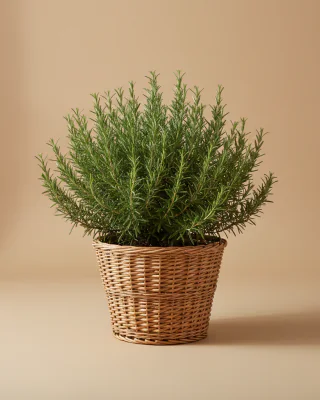
 Not sure it’s this plant?Check yours with a photo, free
At a glance
- Light
- Bright / direct light
- Typical interval
- Every 6 to 8 days
- Climate
- 10–24 °C (50–75 °F)
- Humidity
- 40–60%
- Pet safety
- Pet-safe (non-toxic)
When and how to water
4 cm (1.6 in)
- Every 6 to 8 days
Water your rosemary when the top 4 cm (1.6 in) of soil feel dry to the touch, typically every 6 to 8 days while it grows and flowers. Use room-temperature water and let any excess drain. Never leave the pot sitting in standing water.
Light and placement
Bright / direct light
Rosemary needs several hours of direct sun. Turn the pot every week so it grows evenly. Place it directly in front of a south- or southwest-facing window.
Feeding
Feed your rosemary every 90 days while it’s actively growing. Use a balanced liquid houseplant fertilizer at half the strength on the label, and only on soil that’s already damp. Feeding dry roots can scorch them.
When growth pauses, skip the fertilizer and let it rest.
Temperature & humidity
Climate10–24 °C (50–75 °F)
Humidity40–60%
Rosemary is comfortable between 10 and 24 °C (50–75 °F). Planted out, established plants take light frost to about minus 5 °C (23 °F). In a pot, bring it into a bright, frost-free place once nights fall to about 0 °C (32 °F).
It does best at 40–60% humidity. It doesn’t need misting.
Rosemary Christmas tree
The small cone-shaped rosemary trees sold at Christmas are ordinary rosemary, pruned into a tree shape. They need the same care as any potted rosemary.
Take off the decorative foil, or empty it after every watering, because it traps water around the roots. Stand the pot on a drip tray instead.
Give it the sunniest window you have and turn it every week so every side gets light. Keep it cool and away from radiators and heat vents. In a dark room, a grow light that does not give off heat helps.
Heated rooms dry the pot fast, so feel the soil once or twice a week and water when the top 4 cm (1.6 in) is dry.
The shape slowly changes as it grows and as you snip sprigs for the kitchen. That is normal. In spring, once frost is over, it can go outdoors into full sun and well-drained soil.
Overwintering rosemary
Move potted rosemary into winter quarters once nights fall to about 0 °C (32 °F) and keep it bright and cool at 5 to 12 °C (41–54 °F). Cold, wet soil is more dangerous than dryness.
Common problems
Yellowing, drooping, and dry edges often point to watering or drainage. Compare the signs before changing the routine.
Find what’s wrong
Toxic to pets?
No. Pet-safe.
Rosemary is non-toxic to cats and dogs. Safe to keep in a home with pets.
Pet-safety information in the JungleBook uses ASPCA reference data where available. It is reference information, not veterinary advice.
Sources5 references
- Royal Botanic Gardens, Kew: Plants of the World OnlineTaxonomy · accepted name · included synonym · native range · cultivation · Name status · synonymy to Salvia rosmarinus
- Royal Horticultural SocietyGetting started · Sun · warmth · free-draining soil · containers · winter protection · Synonyms · Position · Growing Conditions · Pests · Diseases
- University of Maryland Extension / Ask ExtensionExpert Response · indoor rosemary guidance
- Iowa State University Extension and OutreachBest Herbs for Indoors · The Best Growing Conditions for Indoor Herbs
- ASPCA Animal Poison ControlScientific name · non-toxicity classification
Last reviewed: