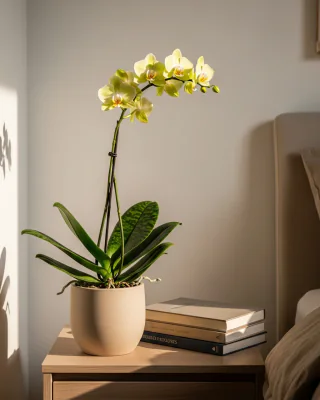
The bark mix is still damp days after watering, and the roots look brown and mushy through the pot instead of plump and silvery-green. Small dark flies around moist potting medium may be fungus gnats. They suggest conditions suitable for breeding, without proving that the surface never dries.
The fix
Inspect the roots and remove soft, rotten roots with clean tools. Replace degraded bark with fresh orchid mix and ensure drainage. Water when the medium is nearly dry, before the roots dry out completely. Keep water out of the crown.
Other possible causes
Not a match? Compare the signs below to find the one you have.
Thirst (underwatering)
How to tell
The bark mix is bone dry, and the yellowing arrives alongside wrinkled leaves rather than soft, mushy growth.
The fix
If the bark is dry and the firm roots look silvery, water thoroughly and let the pot drain completely. Then check the bark and roots before every watering rather than watering on a fixed day.
Too little light
How to tell
Low light alone rarely turns an orchid leaf yellow: the leaves go a darker green instead and the plant stops flowering. If moth orchid also hasn’t bloomed in over a year, the spot is too dim, so check watering and roots first for the yellowing itself.
The fix
Move it to a brighter spot out of direct midday sun. A healthy leaf is a medium olive-green, not dark green (too little light) or reddish (too much).
Hungry (nutrient shortfall)
How to tell
Older leaves fade to an even pale yellow and growth has clearly slowed, usually after many months in the same tired mix.
The fix
Feed with a balanced, diluted liquid fertilizer through the growing season, and refresh the top layer or repot if it’s been over a year.
Simple old age
How to tell
A moth orchid carries only a handful of leaves at a time, so it’s normal for the single oldest, lowest leaf to yellow and drop every year or so, usually right after or during flowering: the plant is redirecting energy, not sick.
The fix
Nothing is wrong. Let the leaf yellow fully and drop on its own, or snip it once it’s mostly yellow.
Thrips
How to tell
Silvery patches with tiny black dots point to thrips.
The fix
Isolate the plant and remove badly damaged flowers or leaves. Avoid soaking the foliage or crown. Use only a thrips treatment labelled for this plant, follow its instructions and test a small area first. If leaves get wet, dry them promptly.