


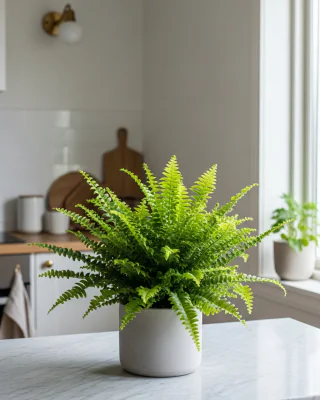
Yellow leaves

Why are my Boston fern's leaves turning yellow?Nephrolepis exaltata

Yellowing is the most common distress signal a Boston fern sends, and it almost always traces back to watering. On this plant it tends to show up as yellowing fronds and mushy crown — here's how to read which cause is yours.

Most likely cause

Thirst (underwatering). Water thoroughly — every 4 to 6 days in summer is the usual pace for a Boston fern — then settle into feeling the soil before every watering rather than watering on a fixed day.
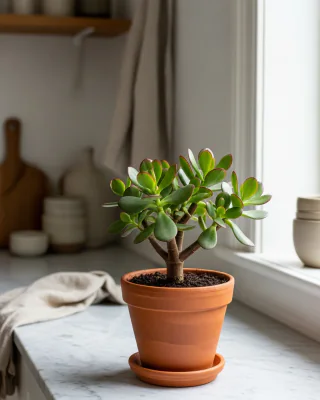
Boston fern (Nephrolepis exaltata) — a healthy specimen photographed indoors
Light
Medium / indirect light
Watering (summer)
every 4 to 6 days
Watering (winter)
every 8 to 12 days
Pet safety
Pet-safe (non-toxic)
Not sure this is it? Snap a photo — the Plant Doctor answers in seconds.Get the app →

What's causing it

Thirst (underwatering)

How to tell: The soil is bone dry, and the yellowing arrives alongside crispy frond tips rather than soft, mushy growth.
The fix: Water thoroughly — every 4 to 6 days in summer is the usual pace for a Boston fern — then settle into feeling the soil before every watering rather than watering on a fixed day.

Too little light

How to tell: The yellowing comes with pale, stretched new growth leaning toward the nearest window — Boston fern is medium / indirect light and won't hold its colour much dimmer than 2,000 - 10,000 lux.
The fix: Move it to a brighter spot within its medium / indirect light range, but keep it out of harsh midday sun, which scorches.

Overwatering & early root rot

How to tell: The soil is still wet days after watering, the lower and oldest leaves yellow first, and the stem base may feel soft — often showing as yellowing fronds. This is the single most common cause on a Boston fern.
The fix: Stop watering. Let the top 1 to 2 cm of soil feel dry — ferns don't like drying out completely, make sure the pot can actually drain, and only water again once it's dry. If the base is mushy or smells sour, unpot it and trim any brown, soft roots before repotting in fresh mix.

Hungry (nutrient shortfall)

How to tell: Older leaves fade to an even pale yellow and growth has clearly slowed — on a plant that likes 60-80% humidity and regular water, this shows up after many months in the same tired mix once feeding has lapsed.
The fix: Feed with a balanced, diluted liquid fertiliser through the growing season, and refresh the top layer or repot if it's been over a year.

Simple old age

How to tell: A single bottom leaf slowly yellows while the rest of the plant looks healthy and is pushing new growth.
The fix: Nothing is wrong — snip the spent leaf off and carry on. Plants retire their oldest leaves.

Not sure which one it is?

Share photos of your Boston fern and a few care details. Botanicaly's Pro Plant Doctor builds a step-by-step rescue plan; try it with the 7-day free trial.

App Store Google Play
Get the app →

Prevention

Check the mix regularly so it never goes bone dry for long, keep humidity up, and give it bright, indirect light.

Common questions

Should I cut off the yellow leaves on my Boston fern?

Once a leaf has gone fully yellow it won't turn green again, so it's fine to snip it at the base — it lets the plant put energy into healthy growth. Don't strip lots at once, though; if many are yellowing, fix the cause first.

Will yellow leaves on a Boston fern turn green again?

No. A fully yellowed leaf is spent. The goal is to stop NEW leaves from yellowing by correcting the cause — usually easing off the watering.

More for your Boston fern

Hand-checked against Botanicaly's verified plant catalog and ASPCA records by the Botanicaly team, led by founder Ludvig Nyström. How we verify our plant data → · Last reviewed: 2026-07-21