

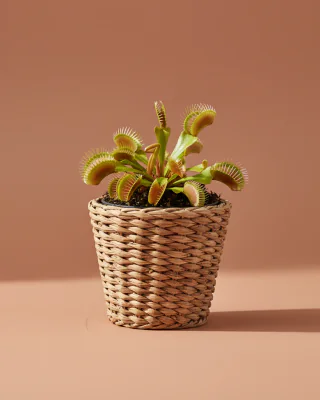
Venus fly trap care guide
Dionaea muscipula

How to keep Venus fly trap healthy at home: how much to water it, the light it needs, and how to catch common problems early.
 Not sure it’s this plant?Check yours with a photo, free
At a glance
- Light
- Bright / direct light
- Watering
- Keep the soil wet
- Climate
- 20–30 °C (68–86 °F), cool winter rest
- Humidity
- No special humidity needed
- Pet safety
- Pet-safe (non-toxic)
When and how to water
Venus fly trap is a bog plant, so its soil should stay wet. While it grows, stand the pot in a shallow saucer of water and top it up before it runs dry. In winter, water less but keep the soil damp. Use rainwater or distilled water, because minerals in tap water build up and harm the roots.
Light and placement
Bright / direct light
Venus fly trap needs several hours of direct sun. Turn the pot every week so it grows evenly. Place it directly in front of a south- or southwest-facing window.
Feeding
Venus fly trap doesn’t need fertilizer, so skip feeding it.
Temperature & humidity
Venus fly trap grows best in warm weather, roughly 20 to 30 °C (68–86 °F) or more in summer. In winter it needs a cool, bright rest at about 0 to 10 °C (32–50 °F), such as an unheated room or a sheltered spot outdoors, so do not keep it in a warm room all winter. Protect it from hard frost.
It needs no special humidity. The wet soil gives it the moisture it needs. It doesn’t need misting.
Common problems
Yellowing, drooping, and dry edges often point to watering or drainage. Compare the signs before changing the routine.
Find what’s wrong
Toxic to pets?
No. Pet-safe.
Venus fly trap is non-toxic to cats and dogs. Safe to keep in a home with pets.
Pet-safety information in the JungleBook uses ASPCA reference data where available. It is reference information, not veterinary advice.
Sources4 references
- Royal Botanic Gardens, Kew: Plants of the World OnlineTaxonomy · accepted name · classification
- North Carolina State University Extension Gardener Plant ToolboxHouseplant context · light · wet medium · water quality · humidity · pests · disease
- Iowa State University Extension and OutreachMedium · light · temperature · humidity · water quality · feeding · terrarium care
- ASPCA Animal Poison ControlScientific name · toxicity classification for dogs, cats and horses
Last reviewed: