


Download on the App StoreGet it on Google Play

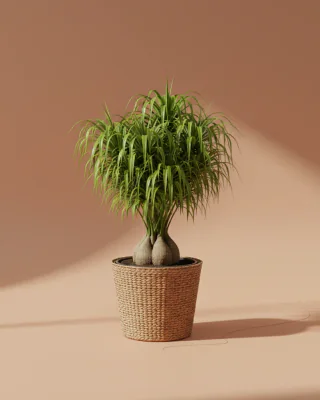
Yellow leaves on ponytail palm: causes and fixes

Beaucarnea recurvata

Quick answer

Yellow leaves on your ponytail palm have a few possible causes, and on this plant the likeliest is overwatering and rot at the base.

Ponytail palm
Not sure it’s this plant?Check yours with a photo, free

Pet-safe

Most likely cause

Overwatering & rot at the base

How to tell

The soil stays wet for days, and the rot starts low: a soft, discolored patch at the base rather than one particular old leaf. Small dark flies around moist potting medium may be fungus gnats. They suggest conditions suitable for breeding, without proving that the surface never dries.

The fix

Stop watering and let the mix dry out. Remove brown, mushy roots with clean tools and repot in fresh, dry, gritty mix in a pot with drainage holes. Extensive rot in the swollen trunk is more serious than root damage and recovery is uncertain. Do not cut off arbitrary shoots above the rot to root them. Propagation uses seed or suitable offsets, not pieces of a rotten trunk.
Other possible causes

Not a match? Compare the signs below to find the one you have.

Too little light

How to tell

The yellowing comes with pale, stretched new growth leaning toward the nearest window. That combination shows that the spot is too dim for a ponytail palm.

The fix

Move it to a sunny window. If it has been somewhere dim for a while, move it over a week or two so it can adjust to the stronger light.

Thirst (underwatering)

How to tell

The soil is bone dry, and the yellowing arrives alongside crispy brown tips rather than soft, mushy growth.

The fix

If the soil is dry, water thoroughly (every 14 to 22 days in summer is the usual pace for a ponytail palm), then settle into feeling the soil before every watering rather than watering on a fixed day.

Hungry (but rarely the real culprit)

How to tell

Ponytail palm grows slowly and needs very little feeding, so a uniform pale-yellow fade after many months without any is possible, but check watering and light first: those are far more common on this plant.

The fix

Use a cactus and succulent fertilizer at half the strength on the label, about every 90 days while it’s actively growing. Overfeeding a slow grower like this does more harm than skipping it.

Simple old age

How to tell

An older, lower leaf slowly yellows or shrivels on its own while new growth looks plump and healthy. That’s normal turnover on a ponytail palm, not a symptom.

The fix

Nothing is wrong. Remove the spent leaf once it comes away easily and carry on.

All ponytail palm guides

Keep reading

Related plants

Last reviewed: