



Which should you choose?
Snake Plant (Sansevieria)
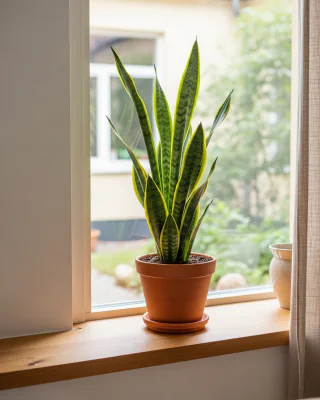
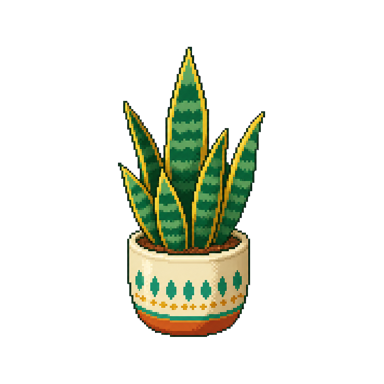
Choose Snake Plant if you want an upright plant. Its sword-like leaves fit narrow shelves and tight corners, and it grows a little faster than the ZZ plant.

ZZ Plant
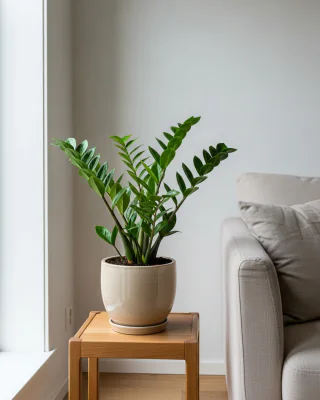
Choose ZZ Plant if you travel often or forget to water. Its thick rhizomes store water, and it goes longer between waterings than the snake plant.
Still unsure? Take the ZZ Plant. Both survive real neglect, but it goes longest between waterings.
Side by side
| Snake Plant (Sansevieria) | ZZ Plant | |
|---|---|---|
| Common shape | Upright sword-like leaves | Arching stems with glossy oval leaflets |
| Water storage | Thick leaves store moisture | Thick rhizomes (root bulbs) store water |
| Origin | West Africa | East Africa |
| Growth speed | Slow to moderate | Slow: one of the slowest-growing |
| Light | Low light tolerant | |
| Watering | Every 11 to 17 days (summer), every 24 to 36 days, sometimes less (winter) | Every 21 days (summer), every 45 days (winter) |
| Difficulty | Easy: nearly indestructible | |
| Pet safety | Toxic to cats and dogs | |
More plant comparisons
Common questions
Which is better for a dark room, Snake Plant or ZZ Plant?
Neither has an edge: both tolerate low light equally well, so choose on shape or watering instead. Both grow more slowly the darker it gets, and neither lasts long in a room with no window unless it gets a grow light.
How long can these plants go without water?
The table above gives each plant’s summer and winter interval. The ZZ plant waits longer than the snake plant, and both wait much longer in winter. The ZZ plant’s rhizomes hold more water than most common houseplants, so it is hard to kill by underwatering.
Are Snake Plant and ZZ Plant safe for cats?
No, both are toxic to cats and dogs. If you need a low-light plant that is pet-safe, consider the Parlor palm (Chamaedorea elegans) or the Cast-iron plant (Aspidistra elatior), both of which tolerate low light and are non-toxic.
Last reviewed: 2026-09-16