



Which should you choose?
Cactus (assortment)
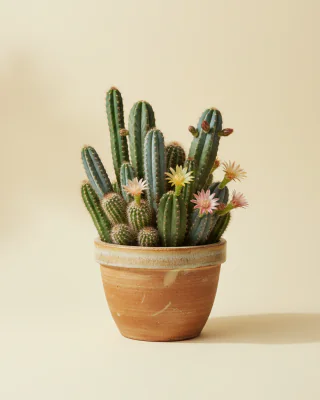
Choose a Cactus if you want a structural, architectural shape and a plant that goes the longest between waterings in winter. Note: spines make them less suitable around small children.
Echeveria (Succulent)
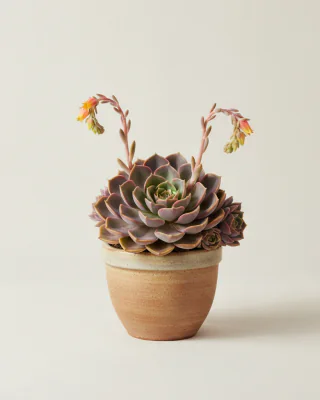
Choose Echeveria if you want the rosette look or a plant without spines. Of the two, it is also the one listed as non-toxic to cats and dogs.
Still unsure? Take the Echeveria. It has no spines and is listed as non-toxic to pets. Both need your brightest window with some direct sun.
Side by side
| Cactus (assortment) | Echeveria (Succulent) | |
|---|---|---|
| Spines | Yes: areoles with spines or glochids | No: smooth, waxy leaves |
| Shape | Columnar, barrel, or paddle forms | Rosette of thick fleshy leaves |
| Watering | Every 11 to 17 days (summer), every 36 to 54 days, sometimes less (winter) | Every 11 to 17 days (summer), every 24 to 36 days, sometimes less (winter) |
| Origin | Americas (desert) | Mexico / Central America |
| Light | Bright / direct light | |
| Flowering | Seasonal blooms, often vivid | Seasonal blooms on tall stalks |
| Difficulty | Easy | |
| Pet safety | Not confirmed pet-safe | Pet-safe (non-toxic) |
More plant comparisons
Common questions
What is the difference between a cactus and a succulent?
All cacti are succulents (they store water), but not all succulents are cacti. Cacti belong to the family Cactaceae and are identified by areoles, specialised cushion-like structures from which spines, flowers, and new growth emerge. Other succulents (Echeveria, Aloe, Haworthia, Sedum) lack areoles and spines.
Which is easier to grow, a cactus or a succulent?
Both are rated easy and are very drought-tolerant. Both need bright light with some direct sun indoors, so give either one your brightest window. The cactus can wait longer between waterings in winter.
Are cacti safe for cats and dogs?
Echeveria is listed as non-toxic by the ASPCA. Cactus is a whole plant family rather than one species, and the ASPCA holds no record for it, so we cannot confirm that every cactus is safe. The main risk from cacti is the physical spines. Keep them out of reach of pets and children.
Last reviewed: 2026-09-16