


Bird of paradise vs banana plant
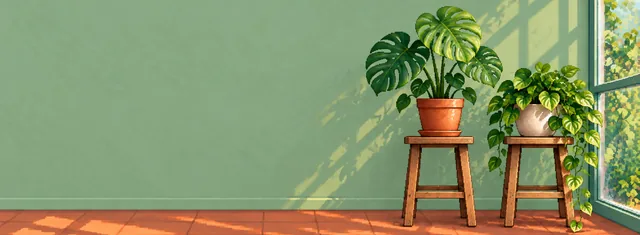
Bird of paradise has upright, paddle-shaped leaves on long stalks. Banana has broad leaves that emerge from a trunk-like stem made of overlapping leaf bases.
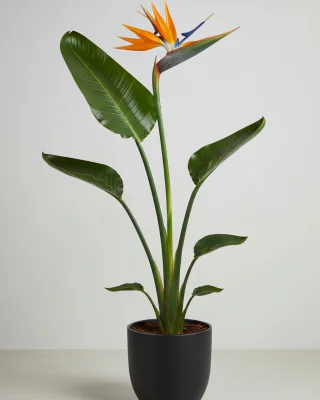
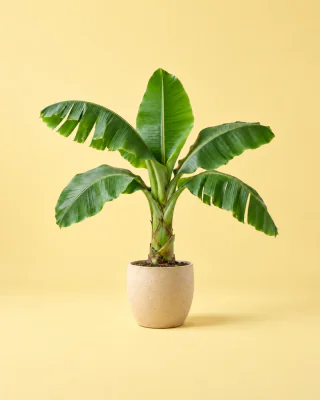
Side by side
| Bird of paradise | Banana plant | |
|---|---|---|
| Plants compared | Strelitzia reginae | Musa acuminata |
| Leaf shape | Firm, paddle-shaped leaves | Broad, elongated leaves |
| Stem structure | Individual long leaf stalks from a clump | A false trunk formed by overlapping leaf bases |
| Flowers | Orange and blue, bird-shaped flowers | Flowers emerge from the leafy false stem |
| Growth habit | An upright clump | A large herbaceous plant with suckers |
| Light | Bright / direct light | |
| Watering | Every 6 to 8 days (summer), every 11 to 17 days (winter) | Every 3 to 5 days (summer), every 6 to 10 days (winter) |
| Pet safety | Toxic to cats and dogs | Pet-safe (non-toxic) |
Which should you choose?
Bird of paradise
Choose Strelitzia reginae for upright, paddle-shaped foliage. It needs strong light, and flowering indoors takes suitable conditions. Do not choose it expecting flowers in a dim corner.
Banana plant
Choose Musa acuminata for broad leaves and a trunk-like outline. Choose a cultivar that fits your available space and provide light, moisture and room for growth.
Check the plant label before choosing care. Similar common names can refer to different species.
More plant comparisons
Common questions
Is bird of paradise a banana plant?
No. Strelitzia reginae and Musa acuminata belong to different genera and families. Their broad leaves can look similar, but the banana’s overlapping leaf bases form a false trunk.
Will an indoor banana plant produce fruit?
Fruit depends on the cultivar and growing conditions. Do not assume that an ornamental indoor plant will produce an edible crop. Check the label and the cultivar’s requirements.
Which of these plants is pet-safe?
Bird of paradise is toxic to cats and dogs. Musa acuminata is pet-safe (non-toxic). Discourage chewing even on a non-toxic plant, because eating plant material can upset a pet’s stomach.
Sources4 references
Last reviewed: