



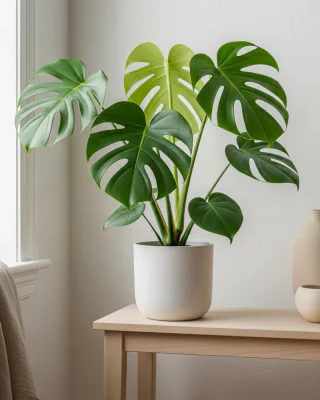
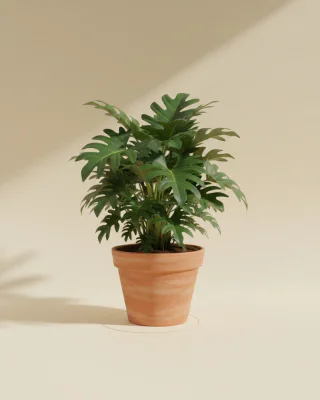
Which should you choose?
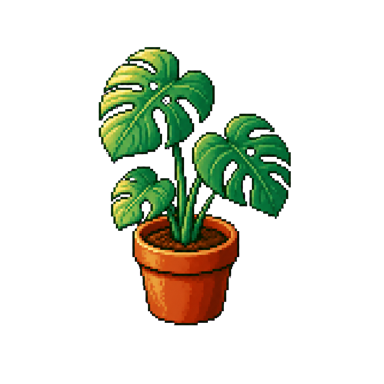
Monstera (Swiss Cheese Plant)
Choose Monstera if you want a climbing statement plant: it grows large, produces the iconic hole-punched leaves as it matures, and responds well to a moss pole.
Tree Philodendron
Choose Tree Philodendron if you want a plant that doesn’t need a support structure. It grows as a compact self-supporting shrub and gets by on medium, indirect light.
Still unsure? Take the Tree Philodendron: it needs no moss pole and no training. Pick the Monstera only if you want that project.
Side by side
| Monstera (Swiss Cheese Plant) | Tree Philodendron | |
|---|---|---|
| Leaf holes | Holes within the leaf (fenestrations) | Deep cuts to the midrib: no enclosed holes |
| Growth habit | Climbs/trails: needs a moss pole | Self-heading shrub: no support needed |
| Stem attachment | Leaves on long, single petioles | Leaves clustered on a self-heading trunk |
| Origin | Central America | South America |
| Light | Bright filtered or indirect light | Medium / indirect light |
| Watering | When the upper mix is almost dry | Every 6 to 8 days (summer), every 11 to 17 days (winter) |
| Difficulty | Easy | |
| Pet safety | Toxic to cats and dogs | |
More plant comparisons
Common questions
What’s the difference between Monstera and Tree Philodendron?
The key difference is in the leaves: Monstera deliciosa has holes (fenestrations) enclosed within the leaf blade, while Philodendron bipinnatifidum has deep cuts that go all the way to the midrib with no enclosed holes. The growth habit also differs: Monstera climbs. The Tree Philodendron forms a self-supporting trunk.
Are both toxic to pets?
Yes, both contain calcium oxalate crystals and are toxic to cats and dogs if ingested. Keep both out of reach of pets.
Which grows faster, Monstera or Tree Philodendron?
Both grow at a similar pace in good indoor light. Monstera can grow significantly larger (up to 3m indoors on a pole), while Tree Philodendron tends to stay more compact as a bushy self-heading plant.
Last reviewed: 2026-09-16