



Which should you choose?
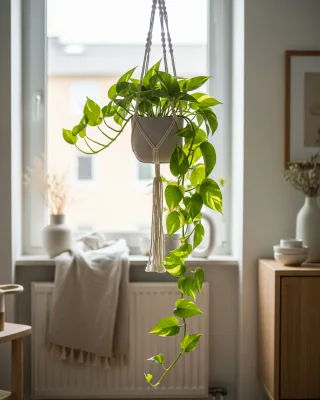
Golden pothos
Choose Pothos if you have a dim corner. Of the two, it is the one that tolerates low light.
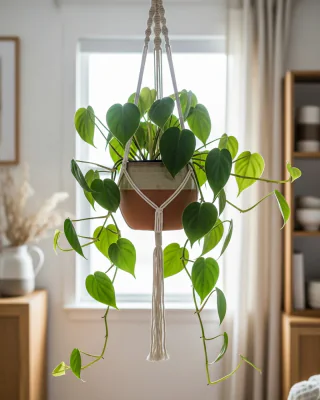
Heartleaf philodendron
Choose Heartleaf Philodendron if your spot gets medium, indirect light and you like thinner, softer leaves.
Still unsure? Take the Pothos. It copes with a darker corner, and the rest is a matter of taste.
Side by side
| Golden pothos | Heartleaf philodendron | |
|---|---|---|
| Leaf texture | Waxy, slightly thicker | Smooth, thinner and softer |
| Petiole | Grooved channel running along the stem | Round stem, no groove |
| Light | Low light tolerant | Medium / indirect light |
| Origin | Society Islands (Pacific) | Caribbean |
| Watering | Every 6 to 8 days (summer), every 11 to 17 days (winter) | |
| Difficulty | Easy: one of the most forgiving plants | Easy: forgiving in medium light |
| Pet safety | Toxic to cats and dogs | |
More plant comparisons
Common questions
Are pothos and philodendron the same plant?
No, they’re different species from different genera. Pothos is Epipremnum aureum. Heartleaf Philodendron is Philodendron hederaceum. They look similar trailing down a shelf, but the petiole (leaf stalk) is the giveaway: Pothos has a grooved channel. Philodendron has a round stem.
Which is easier to grow, Pothos or Philodendron?
Both are rated easy and are among the most forgiving houseplants. Pothos tolerates lower light, so it has a small edge in a dim room. Both follow the same watering rhythm.
Are both plants toxic to cats and dogs?
Yes, both contain calcium oxalate crystals and are toxic to cats and dogs if chewed. If you have pets, consider a Spider plant or a Wax plant instead. Both are listed non-toxic for cats and dogs, and both trail the same way.
Last reviewed: 2026-09-16