



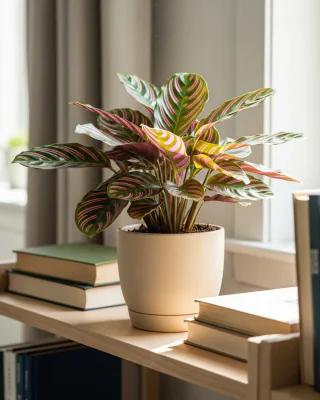
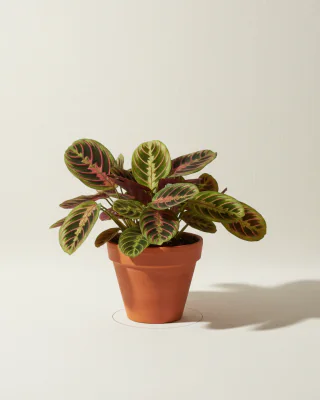
Which should you choose?
Calathea (Pinstripe)
Choose Calathea if you want the pinstripe look: thin pink stripes on dark green leaves. Give it filtered or rainwater every time, because tap water bothers it more than the Maranta.
Prayer Plant (Maranta)
Choose Maranta (Prayer Plant) if you want to watch the leaves fold up every evening, and a plant that is a little less fussy about tap water.
Still unsure? Take the Maranta. Both are fussy about humidity and water quality, but the Maranta minds tap water a little less.
Side by side
| Calathea (Pinstripe) | Prayer Plant (Maranta) | |
|---|---|---|
| Leaf pattern | Thin pink stripes on dark green | Red or light veins with dark blotches |
| Tap water | Very sensitive: use filtered or rainwater | Sensitive: filtered water preferred |
| Difficulty | Moderate: fussier than most | |
| Leaf movement | Folds up at night (nyctinasty) | Folds up at night (more pronounced) |
| Origin | South America | Brazil |
| Humidity needs | High: a humidifier or pebble tray can help | |
| Light | Medium / indirect light | |
| Watering | Every 6 to 8 days (summer), every 11 to 17 days (winter) | Every 6 to 8 days (summer), every 10 to 14 days (winter) |
| Pet safety | Not confirmed pet-safe | |
More plant comparisons
Common questions
Why does my Calathea or Maranta fold its leaves at night?
Both plants practice nyctinasty, a circadian rhythm that causes the leaves to fold upward at dusk, like hands in prayer, and open again at dawn. It’s a natural response, not a sign of stress. If leaves stay folded during the day, that can indicate low light or underwatering.
Are Calathea and Maranta safe for cats and dogs?
We cannot confirm it. Neither Calathea ornata nor Maranta leuconeura appears in the ASPCA’s toxic and non-toxic plant database, and the ASPCA pages carrying those common names describe other species. Keep both out of reach of pets, and call your vet if a pet chews one.
Why is my Calathea or Maranta developing crispy edges?
Crispy leaf edges almost always mean one of three things: low humidity, fluoride/salt build-up from tap water, or drafts from air conditioning. Try filtered or rainwater, keep humidity above 60 %, and move it away from heating and cooling vents.
Last reviewed: 2026-09-16