

Indoor banana care guide
Musa acuminata

Quick answer
Water your indoor banana when the top 3 cm (1.2 in) of soil feel dry to the touch. In summer that’s typically every 3 to 5 days.
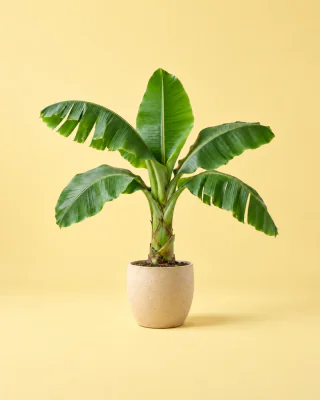
 Not sure it’s this plant?Check yours with a photo, free
At a glance
- Light
- Bright / direct light
- Typical interval
- Every 3 to 5 days · summer
Every 6 to 10 days · winter - Climate
- 18–27 °C (64–81 °F)
- Humidity
- 60–80%
- Pet safety
- Pet-safe (non-toxic)
When and how to water
3 cm (1.2 in)
- Summer · Jun–AugEvery 3 to 5 days
- Winter · Dec–FebEvery 6 to 10 days
Use room-temperature water and let any excess drain. Never leave the pot sitting in standing water.
Adjust the timing for the light at the plant, the pot’s size and material, and the humidity indoors. Terracotta dries faster than glazed ceramic.
Light and placement
Bright / direct light
Indoor banana needs several hours of direct sun. Turn the pot every week so it grows evenly. Place it directly in front of a south- or southwest-facing window.
Feeding
Feed your indoor banana every 30 days while it’s actively growing. Use a balanced liquid houseplant fertilizer at half the strength on the label, and only on soil that’s already damp. Feeding dry roots can scorch them.
When growth pauses, skip the fertilizer and let it rest.
Temperature & humidity
Climate18–27 °C (64–81 °F)
Humidity60–80%
During leafy growth, aim for 18–27 °C (64–81 °F). For routine indoor care, keep it above about 10 °C (50 °F) and avoid cold drafts. This is a care guideline, not an exact damage threshold. Cooler overwintering depends on the species and its rest conditions.
It does best at 60–80% humidity. Occasional misting does not keep humidity high. If the air is too dry, use a humidifier or a suitably humid, well-lit location.
Toxic to pets?
No. Pet-safe.
Indoor banana is non-toxic to cats and dogs. Safe to keep in a home with pets.
Pet-safety information in the JungleBook uses ASPCA reference data where available. It is reference information, not veterinary advice.
Common questions
How often should I water an indoor banana?
Water your indoor banana (Musa acuminata) when the top 3 cm (1.2 in) of soil feel dry to the touch. In summer, that’s typically every 3 to 5 days. In winter, slow down to every 6 to 10 days.
Sources3 references
- Royal Botanic Gardens, Kew: Plants of the World OnlineTaxonomy · accepted name · native range · herbaceous habit · cultivated-banana ancestry
- Royal Horticultural SocietyIdentity · synonym · botanical details · Light · container size · compost · repotting · watering · winter care · warmth · feeding/fruiting
- ASPCA Animal Poison ControlScientific name · non-toxic classification for dogs, cats, and horses
Last reviewed: