



Bromeliad care
Water a bromeliad mostly into its central cup and refresh that water every month or two. Give it bright light without hot sun and a small, free-draining pot.
Most bromeliads sold as houseplants, such as Guzmania, the urn plant and Vriesea, grow as a rosette of leaves around a central cup. Keep that cup topped up with rainwater or distilled water, and empty and refill it every month or two so it does not go stale. Keep the compost just damp, never soggy.
Each rosette flowers only once and then slowly dies. That is normal, not a care mistake. Before it goes, it makes pups at its base, and those grow into the next plants.
Common bromeliads and their care
These are the bromeliads you are most likely to find in a shop. Each guide has the full care for that plant.
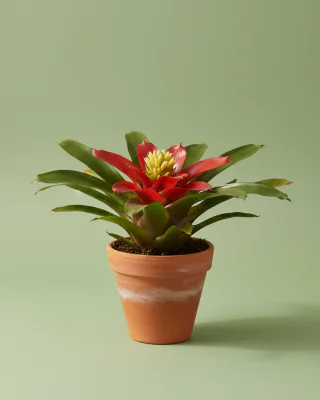
- Scarlet star bromeliad: Bright, indirect light, water in the cup and the compost damp but not soggy in summer, drier between waterings in winter. Pet-safe (non-toxic).
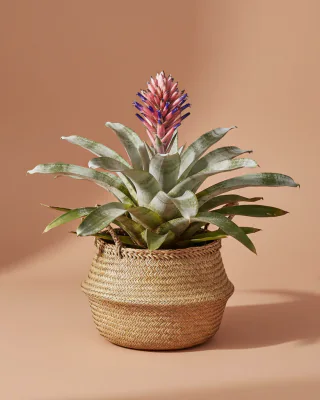
- Urn plant: Bright, filtered light without strong summer sun, water in the cup and a small pot of free-draining compost that never sits wet. Not confirmed pet-safe.
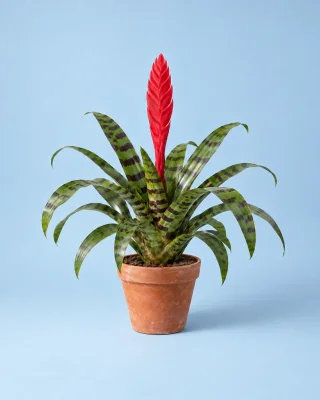
- Vriesea: Bright, indirect light, the cup kept filled and the top half of the mix allowed to dry. Keep it above about 15 °C (59 °F). Not confirmed pet-safe.
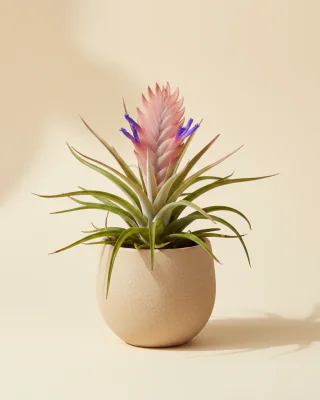
- Pink quill: A potted Tillandsia with a pink flower spike. Bright light with a little gentle sun, and water when the top 2 cm (0.8 in) of the mix feel dry. Not confirmed pet-safe.
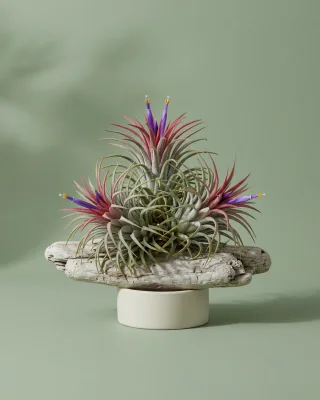
- Air plant: An air plant that grows without soil. Soak it for 20 to 30 minutes, then let it dry upside down so no water sits between the leaves. Not confirmed pet-safe.
How to water a bromeliad
In a bromeliad with a cup, most water goes into the cup. Keep it topped up, ideally with rainwater or distilled water, and every month or two tip it out and refill it so the water does not stagnate.
Water the compost as well, but lightly. The roots are small and rot easily. In summer keep the compost damp but not soggy, and in winter let it dry a little between waterings. Never leave the pot standing in water.
Air plants are the exception. They have no cup and no soil, so they are soaked instead and then dried upside down.
Light and temperature
Bromeliads like bright light, but strong summer sun through glass can scorch the leaves. A spot near an east or west window, or behind a sheer curtain, suits most of them.
The RHS advises about 21 °C (70 °F) in summer to encourage flowering, and a cooler spot of about 12 °C (54 °F) once the flower head has formed to make it last longer. Keep them above 10 °C (50 °F) in winter, and Guzmania and Vriesea above about 15 °C (59 °F), away from radiators and cold drafts.
Humidity, compost and feeding
Bromeliads like humid air. A bright bathroom or kitchen suits them, or stand the pot on a tray of damp gravel with the water below the base of the pot. If you mist, use soft water, because hard water marks the leaves.
Use a small pot and a free-draining mix. The RHS suggests equal parts fine composted bark or orchid compost, grit and coir, or equal parts bark and peat-free multipurpose compost.
Most bromeliads need very little feed, and too much can dull the leaf color. Never put solid fertilizer in the cup. Each plant’s guide says how much it needs.
Why a bromeliad dies after flowering
A rosette bromeliad flowers once in its life. The colorful bracts can last for months, and then the mother rosette slowly fades over the following months. Keep caring for it as normal, because that is when it makes its pups.
A plant bought in flower often has no pups yet. Keep watering it and new shoots usually appear around the base.
Growing new plants from pups
If there is one pup, cut away the old rosette once it has died back and let the pup grow on in the same pot, or replant it in a smaller one.
If there are several, you can keep one in place and pot up the others. The RHS advises cutting them off in spring when they are about a third the size of the mother plant. Pot each in a small pot of free-draining mix and keep it warm and bright, out of direct sun, under a clear plastic bag until it roots.
Be patient. A pup flowers only once it is mature, which takes a few years. For Vriesea that is about 3 to 5 years.
Getting a bromeliad to flower again
A mature rosette that has not flowered yet needs warmth and good light. The RHS also describes a gardener’s trick: ripe apples or bananas give off ethylene gas, which can trigger flowering. Seal the plant with the fruit in a large clear bag for up to two weeks.
This only works on a rosette that is mature enough. The mother rosette that has already flowered will not flower again.
Related plants
Keep reading
Common questions
How often should I water a bromeliad?
Keep the central cup topped up and replace the water every month or two so it does not go stale. Water the compost lightly so it stays just damp in summer and a little drier in winter. Never leave the pot standing in water.
Should you put water in the middle of a bromeliad?
Yes, for bromeliads with a central cup, such as Guzmania, the urn plant and Vriesea. Use rainwater or distilled water if you can, and empty and refill the cup every month or two.
Why is my bromeliad dying after flowering?
That is its natural life cycle. Each rosette flowers once and then slowly dies, after making pups at the base. Keep watering it and grow the pups on.
When do I separate bromeliad pups?
When they are about a third the size of the mother plant, ideally in spring. Cut them off close to the mother, pot each in a small pot of free-draining mix and keep it warm and bright until it roots.
Are bromeliads safe for cats and dogs?
The ASPCA lists Guzmania as non-toxic to cats and dogs. It has no record for the urn plant (Aechmea), Vriesea or these Tillandsias, so their pet safety is not confirmed. Each plant’s guide has the details.
Last reviewed: