



Spider plant varieties and leaf patterns
Chlorophytum comosum
Quick answer
Sort spider plants by stripe placement and habit: marginal Variegatum, central-stripe Vittatum, compact curly Bonnie, or plain green forms.
 Not sure it’s this plant?Check yours with a photo, free
Pet-safe
Spider plant varieties and leaf patterns
- 01
Plant names and labels
Chlorophytum comosum is the accepted species name. Variegatum, Vittatum, and Bonnie are named horticultural forms within that species, not separate species.
The practical groups are plain green forms, marginal-variegated Variegatum types, central-stripe or arching Vittatum types, and compact curly Bonnie types. There are also smaller, curly, all-green, and reversed-variegation forms.
- 02
How the varieties differ
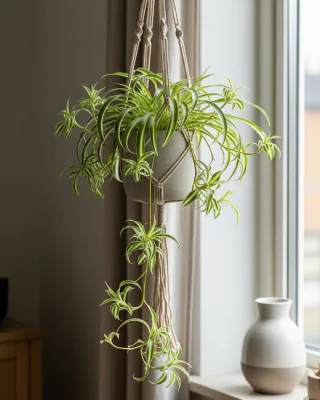
‘Variegatum’ has white marginal stripes, ‘Vittatum’ has central creamy-white stripes and arching leaves, and ‘Bonnie’ is compact and curly with a creamy central stripe. Other named forms include Hawaiian, Milky Way, Picturatum, and White Stripe.
- 03
Care differences
The form changes the container and display decision: arching or trailing Vittatum needs different clearance from compact curly Bonnie, while marginal versus central variegation changes identification. Give every form the same bright, indirect light indoors, out of direct sun. There is no separate watering or feeding schedule by cultivar.
All spider plant guides
Sources3 references
- Royal Botanic Gardens, Kew: Plants of the World OnlineTaxonomy · accepted name · classification
- Royal Horticultural SocietyPosition · watering · feeding · repotting · brown tips · pests
- Clemson University Cooperative ExtensionLight · soil · water · temperature · feeding · pests · tip burn
Last reviewed: