

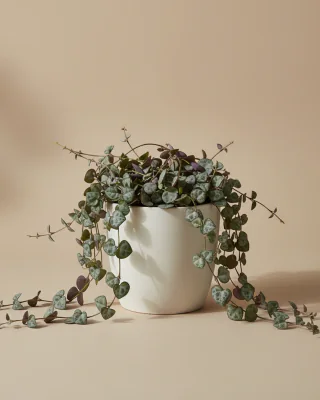
Yellow leaves on String of hearts: causes and fixes
Yellow leaves on String of hearts most often point to a watering problem. On this plant, the first signs are often yellowing leaves and mushy stems. Check the causes below to find which one fits, then follow its fix.
Overwatering & rot at the base. Stop watering completely. Wait until the soil has dried out completely before you even think about the next one, and check the pot actually drains. If the base is soft or smells sour, unpot it, cut away any mushy tissue, and repot in fresh, fast-draining mix.
What’s causing it
Too little light
How to tell
The yellowing comes with pale, stretched new growth leaning toward the nearest window. That combination shows that the spot is too dim for String of hearts.
The fix
Move it to a brighter spot, but keep it out of harsh midday sun, which scorches.
Thirst (underwatering)
How to tell
The soil is bone dry, and the yellowing arrives alongside wrinkled flat leaves rather than soft, mushy growth.
The fix
Water thoroughly (every 8 to 12 days in summer is the usual pace for a String of hearts), then settle into feeling the soil before every watering rather than watering on a fixed day.
Hungry (but rarely the real culprit)
How to tell
String of hearts grows slowly and needs very little feeding, so a uniform pale-yellow fade after many months without any is possible, but check watering and light first: those are far more common on this plant.
The fix
Use a cactus and succulent fertilizer at half the strength on the label, once or twice during the growing season. Overfeeding a slow grower like this does more harm than skipping it.
Simple old age
How to tell
An older, outer leaf near the base slowly yellows on its own while the center keeps producing healthy new growth (normal turnover on a String of hearts, not a symptom).
The fix
Nothing is wrong. Snip the spent leaf off cleanly at its base and carry on.
Prevention
Let it dry out fully between waterings, never let it sit in a saucer of water, and keep it in bright light. Root rot, not thirst, is the real risk on this plant.