


Croton pruning: cut back leggy Codiaeum safely
Codiaeum variegatum
Quick answer
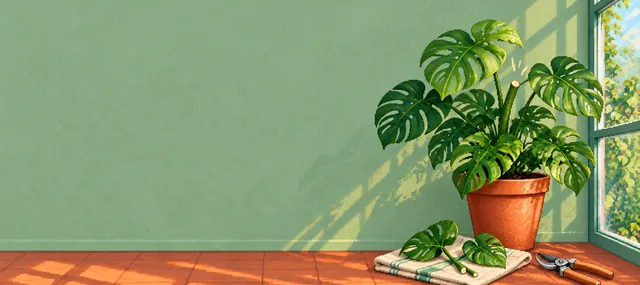
Before pruning, wear gloves, avoid sap on skin and eyes, wash your hands, and keep cut material away from pets. Prune a leggy or misshapen croton above a leaf joint in spring. A stronger reset can cut a leggy Codiaeum variegatum to about 4 inches (10 cm), but that height is not universal.
 Not sure it’s this plant?Check yours with a photo, free
Toxic to pets
Croton pruning: cut back leggy Codiaeum safely
- 01
Choose what to remove
Before pruning, wear gloves, avoid sap on skin and eyes, wash your hands, and keep cut material away from pets. Prune leggy or misshapen shoots just above a leaf joint. A leggy plant can be cut back to about 4 inches (10 cm) for a stronger reset, but retain healthy foliage unless a reset is intentional.
Use pruning to make a tall or straggly croton more compact and encourage leafy side shoots. Do not remove foliage simply because cultivar leaf color differs.
- 02
Prune at the right time
Prune in spring, before or as new growth begins, so the plant can respond with side shoots. Do not make a routine hard cut in a dark winter room.
- 03
Make one clean cut
Use sharp pruning shears just above a leaf joint. For a hard reset, cut a leggy plant back to about 4 inches (10 cm) and dust the wound with powdered charcoal to reduce bleeding. Do not treat 4 inches (10 cm) as a universal height.
- 04
When pruning will not help
Wear gloves and protect your eyes because milky sap can irritate skin and eyes. A severe cut removes photosynthetic foliage, and pruning cannot keep a vigorous tropical shrub at one size forever.
- 05
Care for the plant after pruning
After pruning, keep the plant warm and humid in bright filtered light. Let the root-zone condition guide watering while side shoots develop, and give them time.
All croton guides
Keep reading
Sources2 references
- Royal Botanic Gardens, Kew: Plants of the World OnlineTaxonomy · accepted name · classification
- University of Wisconsin–Madison Division of ExtensionLight · moisture · humidity · temperature · feeding · repotting · pests · sap irritation
Last reviewed: