


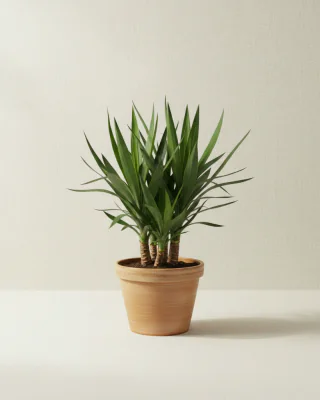
Yellow leaves on Spineless yucca: causes and fixes
Yellow leaves on Spineless yucca most often point to a watering problem. On this plant, the first signs are often yellowing lower leaves and soft trunk base. Check the causes below to find which one fits, then follow its fix.
Overwatering & early root rot. Stop watering. Make sure the pot can actually drain, and wait until the top 7 cm of soil feel dry to the touch. If the base is mushy or smells sour, unpot it and trim any brown, soft roots before repotting in fresh mix.
What’s causing it
Thirst (underwatering)
How to tell
The soil is bone dry, and the yellowing arrives alongside crispy leaf tips rather than soft, mushy growth.
The fix
Water thoroughly (every 14 days in summer is the usual pace for a Spineless yucca), then settle into feeling the soil before every watering rather than watering on a fixed day.
Too little light
How to tell
The yellowing comes with pale, stretched new growth leaning toward the nearest window. That combination shows that the spot is too dim for Spineless yucca.
The fix
Move it to a brighter spot, but keep it out of harsh midday sun, which scorches.
Hungry (nutrient shortfall)
How to tell
Older leaves fade to an even pale yellow and growth has clearly slowed, usually after many months in the same tired mix.
The fix
Feed with a balanced, diluted liquid fertilizer through the growing season, and refresh the top layer or repot if it’s been over a year.
Normal lower-leaf shedding
How to tell
A single lower leaf yellows and drops while the top keeps pushing new growth. Spineless yucca naturally sheds its oldest leaves as the cane grows taller.
The fix
Nothing is wrong. Snip the spent leaf off cleanly at the stem and carry on.
Prevention
Feel the soil before every watering instead of watering on a schedule, give it bright indirect light, and feed lightly in spring and summer.