



How to propagate African violet
Saintpaulia ionantha
African violet propagates best from leaf cuttings in spring or summer. Roots usually appear in 3–4 weeks. New plantlet leaves usually appear in 6–8 weeks.

 Not sure it’s this plant?Check yours with a photo, free
Pet-safe
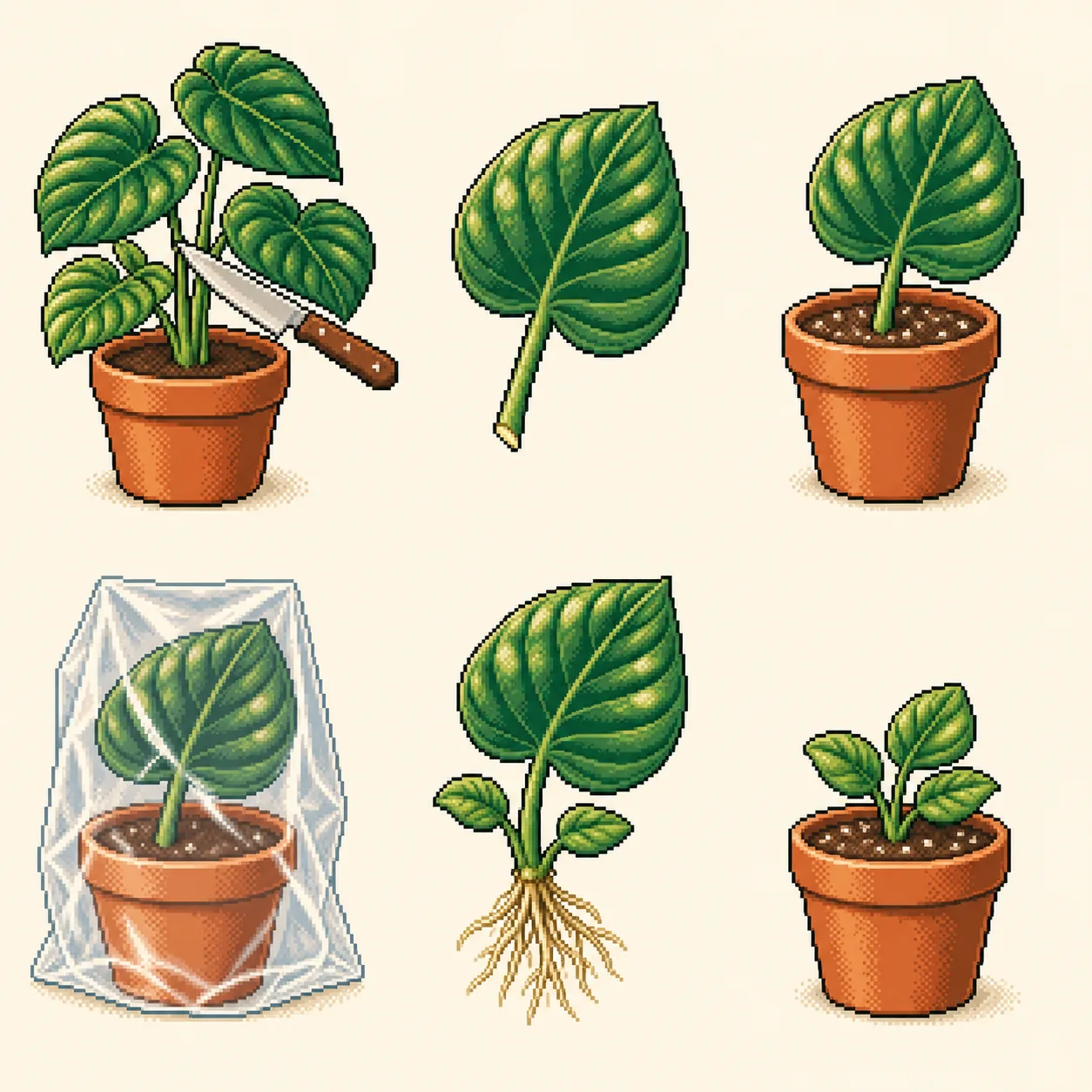
How to propagate by leaf cuttings
African violet can be grown from a single leaf with its stalk. The stalk roots in damp mix, then small plantlets appear at its base.
- 01
Choose a healthy, full-grown leaf from the middle of the plant, not the oldest outer leaves or the newest ones at the center. Spring and summer give the fastest results.
- 02
Cut it with a clean knife, keeping 2–3 cm (0.8–1.2 in) of leaf stalk. Trim the end of the stalk at an angle.
- 03
Push the stalk 1–2 cm (0.4–0.8 in) into a small pot of light seed or houseplant mix with extra perlite, so the leaf stands at a slight angle. Water so the mix is evenly damp.
- 04
Keep the air humid: cover the pot loosely with a clear bag or lid, and open it for a few minutes every few days.
- 05
Place it in bright, indirect light at 18–24 °C (64–75 °F). Keep the mix lightly damp, never soggy.
- 06
Roots usually appear in 3–4 weeks. New plantlet leaves usually appear in 6–8 weeks. Small plantlets follow at the base of the stalk: once they have a few leaves of their own, separate them and pot each one up.
All African violet guides
Keep reading
Related plants

Common questions
What is the best way to propagate African violet?
The most reliable method for African violet (Saintpaulia ionantha) is leaf cuttings. It requires some care but is well within reach of most houseplant owners.
When should I propagate African violet?
The best time is spring to summer, when the plant is actively growing and roots form most quickly.
How long does it take African violet to root?
Roots usually appear in 3–4 weeks. New plantlet leaves usually appear in 6–8 weeks.
Propagation guidance is based on genus-level horticultural knowledge. Individual specimens can vary.
Sources: Iowa State Extension.
6 steps · 3–4 weeks · Last reviewed: