Nerve plant care guide
Fittonia verschaffeltii
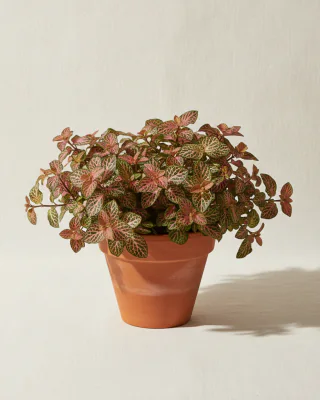
A fittonia, or nerve plant, wants bright, indirect light, lightly moist soil and humid air. If the soil dries out it collapses dramatically, but it usually perks up quickly after a thorough watering.
 Not sure it’s this plant?Check yours with a photo, free
At a glance
- Light
- Bright, indirect, no direct sun
- Water
- Keep the soil just moist, never soggy
- Climate
- Above 17 °C (63 °F), never below 13 °C (55 °F)
- Humidity
- High, a pebble tray or terrarium
- Pet safety
- Pet-safe (non-toxic)
A small plant that shows when it is thirsty
Fittonia comes from the rainforests of South America, where it creeps over the shady forest floor. It is grown for its leaves: dark green with a fine net of white, pink or red veins. It stays small, about 8 to 15 cm (3–6 in) tall, and is also sold under its older name, Fittonia verschaffeltii.
It shows its needs clearly. When the soil dries out, the whole plant wilts and flops over, yet after a thorough watering it usually stands up again. Leaves that wither and shrivel mean the air is too dry or the plant stands in a draft. Yellow leaves usually mean too much water.
Pinch off the stem tips now and then to keep it bushy. Many growers also remove the flower spikes, which are not showy. Its roots are shallow, so a small pot is enough. New plants are easy: in spring, take tip cuttings with three or four pairs of leaves, and the creeping stems even root where they touch the soil. Dwarf forms grow well in a terrarium.
When and how much water
While it grows, water moderately so the compost stays just moist, never waterlogged. Water until it runs out of the pot, then empty the saucer. Many growers end up watering about twice a week, but check the soil rather than counting days.
If it collapses because it dried out, water it thoroughly straight away and it usually recovers. In winter keep the compost only barely moist. Yellow leaves are the first sign of too much water, and soggy compost leads to root rot.
Light and placement
Give it a bright spot out of direct sun, such as a north or east window, or a place with dappled light. Direct sun scorches the leaves. It also grows well under artificial light.
Feeding
While it grows, from spring to late summer, feed it once a month with a balanced liquid fertilizer. Do not feed it in winter.
Temperature & humidity
Keep it warm, ideally above 17 °C (63 °F), and never below 13 °C (55 °F). Normal room temperature suits it. Keep it out of cold drafts and away from radiators.
Humid air is essential. Leaves that wither and shrivel are a sign the air is too dry. Stand it on a tray of wet pebbles and top up the water as it evaporates, or use a room humidifier. A bright bathroom or a terrarium suits it well.
Toxic to pets?
No. Pet-safe.
ASPCA lists the nerve plant (Fittonia verschaffeltii) as non-toxic to cats, dogs and horses. As with any plant, eating it can still upset a pet’s stomach.
Pet-safety information in the JungleBook uses ASPCA reference data where available. It is reference information, not veterinary advice.
Common questions
How often should I water a fittonia?
Moderately, so the soil stays just moist. For many people that works out at about twice a week while it grows, but check the soil first and empty the saucer after watering. In winter keep it only barely moist.
Why is my fittonia wilting?
Usually it is thirsty. A fittonia collapses dramatically when the soil dries out, but it usually perks up quickly after a thorough watering. If the soil is wet and it still droops, it has had too much water.
Why are my fittonia’s leaves turning yellow?
Usually too much water. Let the surface of the soil dry a little before you water again, and empty the saucer.
Why are my fittonia’s leaves shriveling?
Dry air or drafts. Raise the humidity with a pebble tray or a humidifier, and move it away from drafts and radiators.
Does a fittonia need sun?
No direct sun. It wants bright, indirect light, such as a north or east window, because direct sun scorches the leaves. It also grows well under artificial light.
Can a fittonia grow in a terrarium?
Yes. Dwarf forms do very well in the humid air of a terrarium. Pinch the tips now and then to keep it compact.
Is a fittonia safe for cats and dogs?
Yes. ASPCA lists the nerve plant (Fittonia verschaffeltii) as non-toxic to cats, dogs and horses. Eating any plant can still cause a mild upset stomach.
Sources
- This guide follows established plant-care guidance and official ASPCA pet-safety references. How we verify our plant data →
- Sources: the RHS fittonia guide and its Fittonia albivenis Argyroneura Group profile support the light, the warmth above 17 °C (63 °F), the humidity, the watering, the monthly feed and the cuttings. The Missouri Botanical Garden Plant Finder supports the 13 °C (55 °F) minimum, the humidity tray, yellow leaves from overwatering, pinching and terrariums. NC State Extension supports the dramatic wilting, the shallow roots and growing under artificial light. The ASPCA nerve plant record supports the pet-safety wording.
Last reviewed: