


Snake plant varieties
Sansevieria trifasciata
Quick answer
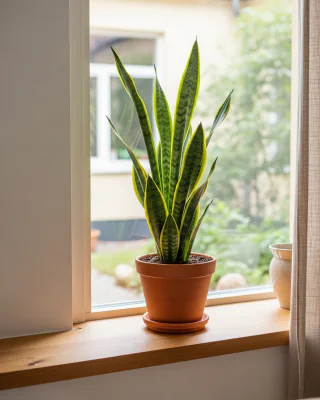
Choose a snake plant form by your space and light: Hahnii stays a dwarf rosette, while taller forms suit a floor planter. All-green examples tolerate lower light.
 Not sure it’s this plant?Check yours with a photo, free
Toxic to pets
Snake plant varieties
- 01
Plant names and labels
Dracaena trifasciata is the accepted name. Sansevieria trifasciata is a synonym and remains the familiar garden name.
Useful houseplant groups include tall upright sword-leaf plants, compact dwarf rosettes such as Hahnii, larger floor-planter forms such as Laurentii, and variegated or silver-leaved forms.
- 02
How the varieties differ
Examples include ‘Hahnii’ as a dwarf rosette, ‘Laurentii’ with yellow edges, ‘Moonshine’ with silvery-gray leaves and green margins, and ‘Bantel’s Sensation’ with white stripes.
- 03
Care differences
For low-light spots, choose all-green examples such as ‘Pineapple’, ‘Moonshine’ and ‘Hahnii’. All forms suit brighter light. Taller trifasciata plants may flop in very low light.
- 04
Limits of plant labels
Do not promise identical appearance, size or low-light performance from a common-name label alone. Cultivar availability and the boundary between species, hybrids and trade names require an identity check.
All snake plant guides
Sources3 references
- Royal Botanic Gardens, Kew: Plants of the World OnlineAccepted name · homotypic synonym Sansevieria trifasciata · classification · Taxonomic synonymy · link to Dracaena trifasciata
- North Carolina State University Extension Gardener Plant ToolboxLow-light tolerance · partial sun · dry-down · winter watering · low humidity · cool temperature · pests and root rot
- Royal Horticultural Society15–24°C (59–75 °F) · low humidity · sun to light shade · free-draining compost · dry-down · pet warning · Full sun to light shade · free-draining peat-free compost · above-10°C (50 °F) warning
Last reviewed: