Staghorn fern care guide
Platycerium bifurcatum

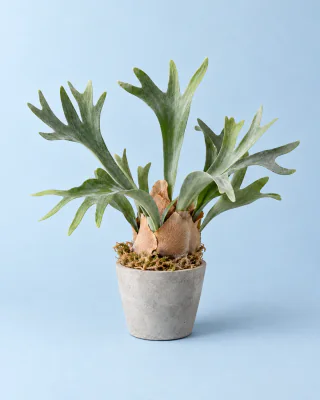
A staghorn fern grows on wood, not in soil. The flat brown fronds at its base are normal, so leave them in place.
 Not sure it’s this plant?Check yours with a photo, free
At a glance
- Light
- Bright, indirect or filtered light
- Water
- Soak the mount when the moss is nearly dry
- Climate
- 16–28 °C (61–82 °F), a little cooler at night
- Humidity
- High, mist every 2 days in a warm room
- Pet safety
- Pet-safe (non-toxic)
Two kinds of fronds, and why it lives on a board
In the wild the staghorn fern grows on tree trunks and branches, with no soil at all. It has two kinds of fronds. The flat, rounded shield fronds at the base hold it to its support, cover the roots and catch water and fallen leaves. They turn brown and papery as they age, which is normal, so leave them in place. The gray-green, forked fronds that give it its name reach outward or hang down, and the brown, felty patches under their tips carry spores. They are not a disease.
That is why it grows best mounted. Shape a mound of sphagnum moss on a wooden board, a slab of bark or a wire basket, set the fern on it with the shield fronds touching the moss, and tie it on with fishing line, plastic strips or nylon. Never use copper wire. Young plants are often sold in pots, which works while they are small if the mix is an airy orchid or sphagnum mix that drains well.
Move it to a larger mount when the shield fronds reach the edges, although it copes with being crowded. Small plantlets, called pups, grow from the base. You can separate them with their roots and mount each one on its own board.
How to water a staghorn fern
Water by soaking. Take the fern down and put the board or basket in a sink or tub of water until the moss is soaked through. Let it drain before you hang it back up. A fern in a pot can be watered from below.
Soak it again when the moss feels almost dry and the fronds look slightly limp. In warm, dry weather that is usually about once a week, in cool or cloudy weather less often. Let it dry a little between soaks, but never completely. Too much water is the most common way to lose a staghorn fern, because a base that stays wet rots.
Light and placement
Give it bright, indirect or filtered light, close to a window but out of strong direct sun. A north window works well. In very low light it grows weakly and is more prone to pests and disease.
Feeding
Feed it with a balanced liquid fertilizer, with equal parts nitrogen, phosphorus and potassium, at the strength on the label. A young fern can have it once a month in the warm months and every other month in the cool months. A large, mature fern needs only one or two feeds a year. For a mounted fern, add the fertilizer to the soaking water.
Temperature & humidity
It grows best at about 20 °C (68 °F) by day, with nights a few degrees cooler. Keep it between 16 and 28 °C (61–82 °F) indoors and away from radiators. It can survive a short cold spell close to freezing outdoors, but it does not tolerate frost.
It likes humid air and takes in water through its fronds as well as its roots. In a warm, heated room, mist it about every two days. A bright bathroom also suits it. Air that stays very damp can cause black spots on the fronds, so misting every two days is enough.
Toxic to pets?
No. Pet-safe.
ASPCA lists the common staghorn fern (Platycerium bifurcatum) as non-toxic to cats, dogs and horses. As with any plant, eating it can still upset a pet’s stomach.
Pet-safety information in the JungleBook uses ASPCA reference data where available. It is reference information, not veterinary advice.
Common questions
How often should I water a staghorn fern?
Soak it when the moss is almost dry and the fronds look slightly limp. In warm, dry weather that is usually about once a week, and less often when it is cool or cloudy. Let it drain before you hang it back up.
How do you water a staghorn fern on a board?
Take it down and put the mount in a sink or tub of water until the moss is soaked through, then let it drain. In a warm room, also mist the fronds about every two days.
Why are the leaves at the base of my staghorn fern turning brown?
Those are the shield fronds. They turn brown and papery as they age, which is normal. They protect the roots and help hold water, so do not remove them.
Why is my staghorn fern turning black?
Usually too much water. A base that stays wet rots, so let the moss dry a little more between soaks. Black spots on the fronds can also appear when the air stays very damp.
Does a staghorn fern need sun?
It needs bright, indirect or filtered light, not strong direct sun. In very low light it grows weakly and is more prone to pests.
How do you mount a staghorn fern?
Shape a mound of sphagnum moss on a board, a slab of bark or a wire basket. Set the fern on it with the shield fronds touching the moss, and tie it on with fishing line, plastic strips or nylon. Do not use copper wire.
Is a staghorn fern safe for cats and dogs?
Yes. ASPCA lists the common staghorn fern as non-toxic to cats, dogs and horses. Eating any plant can still cause a mild upset stomach.
Sources
- This guide follows established plant-care guidance and official ASPCA pet-safety references. How we verify our plant data →
- Sources: NC State Extension supports the mounting, the shield fronds, the light and watering until the roots are almost dry. UF/IFAS Gardening Solutions supports how often to water, the overwatering risk, the feeding, the mounting materials, the pups and its cold tolerance. The New York Botanical Garden supports soaking and misting in a warm room. The Royal Horticultural Society supports regular misting and the temperature range. Clemson Extension and University of Illinois Extension support the light, the humidity and leaving the brown shield fronds in place. The ASPCA common staghorn fern record supports the pet-safety wording.
Last reviewed: