Maidenhair fern care guide
Adiantum raddianum
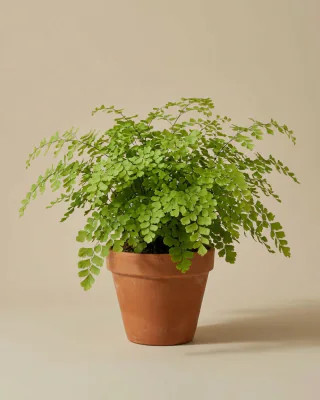
A maidenhair fern must never dry out. Dry soil or dry air quickly turns its fine fronds brown and crispy.
 Not sure it’s this plant?Check yours with a photo, free
At a glance
- Light
- Bright, indirect, a north window is ideal
- Water
- Keep the soil moist, never let it dry out
- Climate
- 16–21 °C (61–70 °F) by day, cooler at night
- Humidity
- High
- Pet safety
- Not confirmed pet-safe
Why it is fussier than other ferns
The maidenhair fern comes from tropical South America. Its fronds are made of many small, thin leaflets on black, wiry stalks. Those thin leaflets lose water quickly, so dry air or a root ball that dries out turns them brown much faster than on a fern with tough, leathery leaves. Extension services rate it as one of the harder ferns to keep in an ordinary home.
It does best in a bright, humid room. A bright bathroom or a terrarium suits it well. Keep it away from radiators and heating vents, which dry the air, especially in winter.
Repot it in early spring, when it fills its pot, into peat-free houseplant compost that drains quickly. You can divide the clump at the same time: cut the rhizomes into pieces that each have roots and fronds. Do not feed a freshly repotted fern for about six months.
When and how much water
Keep the soil evenly moist all the time. Water as soon as the surface starts to feel dry, until water runs out of the bottom of the pot, then empty the saucer so the roots do not stand in water. Do not let the root ball dry out.
In winter it grows more slowly, so it needs water less often, but check the soil every few days and still never let it dry out. Soggy soil is the opposite risk and leads to root rot, so use a mix that drains quickly.
Light and placement
Give it bright, indirect light. The light of a north window is ideal, and a spot a little back from an east or west window works too. Keep it out of direct sun. Deep shade weakens it as well.
Feeding
From mid-spring to late summer, feed it once a month with a general liquid houseplant fertilizer at half the label strength. Do not feed it in winter.
Temperature & humidity
Climate16–21 °C (61–70 °F) by day, cooler at night
It grows best at about 16 to 21 °C (61–70 °F) during the day, with nights a few degrees cooler, around 10 to 16 °C (50–61 °F). Normal room temperature suits it. Keep it away from radiators and heaters.
It needs high humidity. Stand the pot on a tray of wet gravel or pebbles, with the pot above the water, or use a humidifier. Low humidity is the most common reason the leaflets turn brown, especially in winter when the heating is on. It also likes good ventilation, so avoid a stuffy corner.
Not confirmed pet-safe
Common questions
How often should I water a maidenhair fern?
Often enough that the soil never dries out. Water as soon as the surface starts to feel dry, until water runs out of the pot, and empty the saucer. In winter it needs water less often, but it still must not dry out.
Why is my maidenhair fern turning brown and crispy?
Usually the soil dried out or the air is too dry. Keep the soil evenly moist and raise the humidity with a tray of wet pebbles or a humidifier. Keep it away from radiators.
Does a maidenhair fern need humidity?
Yes. It needs high humidity. A tray of wet pebbles under the pot, a humidifier, a bright bathroom or a terrarium all help.
Where should I put a maidenhair fern?
In bright, indirect light, ideally near a north window or a little back from an east or west window. Keep it out of direct sun and away from heaters. A bright bathroom suits it well.
What temperature does a maidenhair fern need?
About 16 to 21 °C (61–70 °F) during the day and a few degrees cooler at night, around 10 to 16 °C (50–61 °F). Normal room temperature is fine.
When should I repot or divide a maidenhair fern?
In early spring, when it fills its pot. Use peat-free houseplant compost and divide the clump into pieces that each have roots and fronds. Wait about six months before you feed it again.
Is a maidenhair fern safe for cats and dogs?
We cannot confirm that. ASPCA has no record for maidenhair ferns, so there is no reliable verdict either way. Keep it out of reach of pets and call your vet if your pet eats some.
Sources
- This guide follows established plant-care guidance and official ASPCA pet-safety references. How we verify our plant data →
- Sources: the RHS Adiantum raddianum profile supports the light, compost, watering, feeding, humidity tray, ventilation and division. NC State Extension supports keeping the roots from drying out, the shade and humid spots such as bathrooms and terrariums. Clemson Extension supports the temperatures, the brown leaflets in dry air, root rot, repotting and the pause in feeding. The ASPCA plant database has no record for maidenhair ferns, so pet safety is not confirmed.
Last reviewed: