Bird’s nest fern care guide
Asplenium nidus
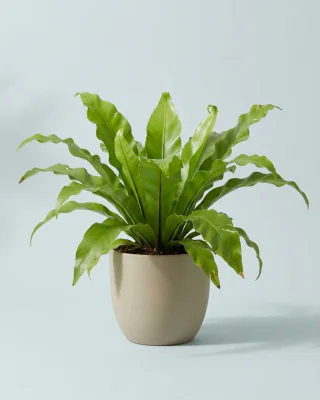
Water a bird’s nest fern when the top 2.5 cm (1 in) of soil is dry, and pour the water around the edge of the pot, not into the center of the rosette.
 Not sure it’s this plant?Check yours with a photo, free
At a glance
- Light
- Bright, indirect, a north or east window
- Water
- When the top 2.5 cm (1 in) is dry, at the pot’s edge
- Climate
- 16–21 °C (61–70 °F), at least 13 °C (55 °F)
- Humidity
- High, a pebble tray helps
- Pet safety
- Not confirmed pet-safe
Why you water around the nest
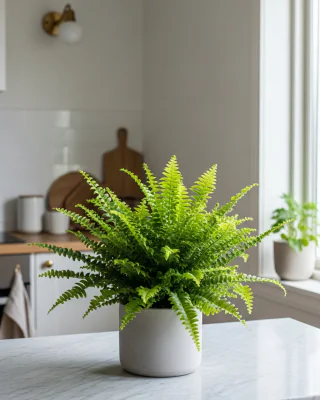
In the wild the bird’s nest fern grows on rainforest trees. Its glossy, undivided fronds grow from a central crown and form a vase-shaped rosette with a hollow in the middle, the nest, where fallen leaves collect. Indoors the fronds usually reach 45 to 60 cm (18–24 in).
Keep water out of that crown. Pour it onto the soil around the edge of the pot and keep it off the fronds. The fronds are fragile, so handle them gently.
It grows slowly and needs a new pot only every few years. Repot it in spring, when new growth starts, into a rich, well-drained mix with plenty of organic matter, such as a fern or tropical plant mix.
When and how much water
2.5 cm (1 in)
When the top 2.5 cm (1 in) is dry, at the pot’s edge
Water when the top 2.5 cm (1 in) of soil feels dry. Pour the water around the edge of the pot until it runs out of the bottom, keep it out of the center of the rosette, and empty the saucer. A pot that stands in water leads to root rot.
Do not let the soil dry out completely, because it does not cope with drought. Keep it evenly moist but never soggy. In winter it grows more slowly and the soil dries more slowly too, so check it with your finger rather than watering on a fixed day.
Light and placement
Give it bright, filtered light, such as a north or east window. Too much direct sun turns the fronds yellow and can stop growth. It tolerates some shade, but deep shade does not suit it either.
Feeding
From late spring through summer, feed it once a month with a liquid houseplant fertilizer at half the strength on the label. Do not feed it in winter.
Temperature & humidity
Climate16–21 °C (61–70 °F), at least 13 °C (55 °F)
It does best at about 16 to 21 °C (61–70 °F). Keep it above 13 °C (55 °F) indoors, and away from heat vents, fireplaces and cold drafts. It does not survive temperatures below about 4 °C (39 °F). In summer it can stand outside in the shade after the last frost, but bring it back in before nights drop below 10 °C (50 °F).
It needs fairly high humidity, which can be hard to give it indoors in winter. Stand the pot on a tray of pebbles and water, with the pot resting on the pebbles and not in the water, or put a humidifier nearby. A bright bathroom also suits it.
Not confirmed pet-safe
Common questions
How often should I water a bird’s nest fern?
When the top 2.5 cm (1 in) of soil is dry. Water until it runs out of the pot, empty the saucer and do not let the soil dry out completely.
Should you water into the center of a bird’s nest fern?
No. Pour the water onto the soil around the edge of the pot and keep it off the fronds and out of the central crown.
Why are the leaves of my bird’s nest fern turning yellow?
Too much direct sun turns the fronds yellow and can stop growth, so move it to bright, indirect light. Roots that stand in water can also rot, so empty the saucer after watering.
Why are the edges of my bird’s nest fern turning brown?
Usually the air is too dry or the soil dried out. Raise the humidity with a pebble tray or a humidifier, keep it away from heaters and do not let the soil dry out completely.
Where should I put a bird’s nest fern?
In bright, indirect light, such as a north or east window, away from heat vents and fireplaces. A bright bathroom is a good spot because the air is more humid.
What is the lowest temperature for a bird’s nest fern?
Keep it above 13 °C (55 °F) indoors. It grows best at 16 to 21 °C (61–70 °F) and does not survive temperatures below about 4 °C (39 °F).
Is a bird’s nest fern safe for cats and dogs?
We cannot confirm that. ASPCA has no record for the bird’s nest fern. It lists only a relative, the mother fern (Asplenium bulbiferum), as non-toxic, and that does not cover this species. Keep it out of reach of pets and call your vet if your pet eats some.
Sources
- This guide follows established plant-care guidance and official ASPCA pet-safety references. How we verify our plant data →
- Sources: Clemson Extension’s bird’s nest fern guide supports the watering at the edge of the pot, the light, the humidity tray, the feeding, the repotting and the summer outdoors. The Missouri Botanical Garden Plant Finder supports the indoor temperatures, the even moisture, the humidity and the frond size. NC State Extension supports the effect of too much sun, the soil and its cold limit. The RHS Asplenium nidus profile and Clemson’s indoor ferns fact sheet agree on the light and the shade. The ASPCA plant database has no record for this species, so pet safety is not confirmed.
Last reviewed: