



Types of ficus houseplants
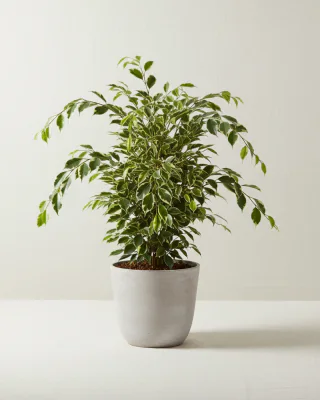
Ficus benjamina
Quick answer
Common types of ficus houseplants are rubber plant, fiddle-leaf fig, weeping fig, ginseng ficus, creeping fig and Audrey. Rubber plant has thick, glossy oval leaves, fiddle-leaf fig has broad violin-shaped leaves and weeping fig has smaller pointed leaves on drooping branches. Creeping fig is a climber rather than an indoor tree. All six named types are toxic to cats and dogs.
 Not sure it’s this plant?Check yours with a photo, free
Toxic to pets
Types of ficus houseplants
- 01
Rubber plant (Ficus elastica)
Rubber plant has thick, glossy, oval leaves. Cultivars such as Tineke and Burgundy change the leaf color and pattern, not the species.
Grow it in bright, indirect light with protection from afternoon sun. Avoid overwatering and reduce watering when growth slows. Its milky sap can irritate skin.
Pet safety: toxic to cats and dogs. Keep it out of reach.
- 02
Fiddle-leaf fig (Ficus lyrata)
Fiddle-leaf fig has broad leaves shaped like a violin, unlike the simpler oval leaves of rubber plant. It grows upright as an indoor tree.
Give it bright, indirect light and moist, well-drained soil. It is sensitive to overwatering, so do not keep the pot soggy.
Pet safety: toxic to cats and dogs. Keep it out of reach.
- 03
Weeping fig (Ficus benjamina)
Weeping fig has drooping branches and small, glossy leaves ending in long points. Its finer branching gives it a different outline from a rubber plant.
Keep its light conditions steady. NC State notes that moving it to different light can trigger leaf drop. Water often enough to prevent the whole pot drying out, with good drainage.
Pet safety: toxic to cats and dogs. Keep it out of reach.
- 04
Ginseng ficus (Ficus microcarpa)
Ficus microcarpa is commonly grown as bonsai. The RHS describes ginseng fig as having a swollen trunk base and small leaves that give it a miniature-tree outline.
It is a tropical fig that needs warmth and humidity. Avoid overwatering, which can cause root rot. ‘Ginseng’ describes a form of this fig, not an edible ginseng plant.
Pet safety: toxic to cats and dogs. Keep it out of reach.
- 05
Creeping fig (Ficus pumila)
Creeping fig has small, heart-shaped juvenile leaves on climbing stems. It attaches to supports with short roots, unlike the upright tree forms of ficus.
Indoors, give it bright, indirect light or partial shade and regular watering during growth. It likes humid air. Prune it to contain the climbing growth.
Pet safety: toxic to cats and dogs. Keep it out of reach.
- 06
Audrey ficus (Ficus benghalensis ‘Audrey’)
Audrey is a cultivar of the Bengal fig, Ficus benghalensis. Its green, oval leaves have pale veins, rather than the cream patches of variegated rubber plants.
Give it bright, indirect light and good drainage. NC State recommends watering Bengal fig when the top of the soil has dried, then emptying excess water from the saucer.
Pet safety: toxic to cats and dogs. Keep it out of reach.
- 07
Care differences between indoor ficus types
Choose for both leaf shape and growth habit. Creeping fig needs room to climb or trail, while the tree types need upright space. Weeping fig is especially sensitive to a change in light, so keep its position steady.
Follow the care guide for the named species rather than treating every ficus the same. Check the pet verdict beside each type. Keep all six away from cats and dogs.
Common questions
Is Audrey a rubber plant?
No. Audrey is a cultivar of Ficus benghalensis. Rubber plant is Ficus elastica. Both belong to Ficus, but they are different species.
Which ficus is a climbing houseplant?
Creeping fig, Ficus pumila. Its small juvenile leaves grow along stems that attach to supports with short roots. The other types listed here are grown as trees or bonsai.
Are ficus houseplants safe for cats and dogs?
The six named types on this page are toxic to cats and dogs. Keep them out of reach, and contact a veterinarian if a pet chews one.
All weeping fig guides
Sources8 references
- NC State Extension Plant Toolbox: Ficus elastica
- NC State Extension Plant Toolbox: Ficus lyrata
- NC State Extension Plant Toolbox: Ficus benjamina
- NC State Extension Plant Toolbox: Ficus microcarpa
- NC State Extension Plant Toolbox: Ficus pumila
- NC State Extension Plant Toolbox: Ficus benghalensis
- RHS: How to grow ornamental figs
- ASPCA: Weeping fig
Last reviewed: