



Types of calathea and prayer plants
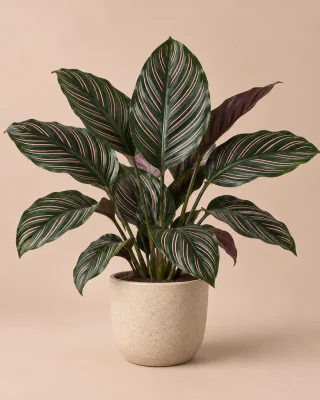
Calathea ornata
Quick answer
Common types of calathea include pinstripe, peacock, rattlesnake, orbifolia, zebra, rose-painted, furry feather and network plants. Pinstripe has fine pink lines, rattlesnake has long spotted leaves and orbifolia has broad silver-striped leaves. These eight species now belong to Goeppertia. They share a need for indirect light, warmth, humid air and moist, well-drained soil.
 Not sure it’s this plant?Check yours with a photo, free
Pet-safe
Types of calathea and prayer plants
- 01
Pinstripe calathea (Goeppertia ornata)
Look for fine pinkish-white lines across dark green, oval leaves, with purple underneath. The stripes are much finer than the broad bands on zebra calathea.
Give it bright, indirect light and keep the mix moist with good drainage. It needs humid air, just like the other calatheas here.
Pet safety: non-toxic to cats and dogs.
- 02
Peacock plant (Goeppertia makoyana)
Peacock plant has thin, pale green to cream leaves with dark blotches and feather-like markings. The pattern repeats in reddish-purple on the underside.
Keep its soil moist without making it soggy. NC State notes that both dry soil and low humidity can damage this type.
Pet safety: non-toxic to cats and dogs.
- 03
Rattlesnake plant (Goeppertia insignis)
Rattlesnake plant, still sold as Calathea lancifolia, has long, narrow leaves with wavy edges. Alternating large and small dark spots sit on a light green background, with purple below.
It needs the same moist, well-drained mix and humid air as pinstripe calathea. Avoid cold drafts and sudden temperature changes.
Pet safety: non-toxic to cats and dogs.
- 04
Orbifolia calathea (Goeppertia orbifolia)
Orbifolia has broad, rounded leaves with silver-green stripes. The round shape separates it from the narrow-leaved rattlesnake plant.
Its care follows the same warm, humid, indirect-light routine. Keep the pot draining freely rather than leaving the roots in water.
Pet safety: non-toxic to cats and dogs.
- 05
Zebra calathea (Goeppertia zebrina)
Zebra calathea has velvety dark green leaves with broad, light green bands along the veins. It is a different plant from the flowering zebra plant, Aphelandra squarrosa.
It needs consistently humid air and moist, well-drained soil. Rainwater or distilled water can help avoid the leaf-tip damage NC State links to fluoride in tap water.
Pet safety: non-toxic to cats and dogs.
- 06
Rose-painted calathea (Goeppertia roseopicta)
Rose-painted calathea has glossy, oval leaves with pink or cream markings near the middle and edges. The underside is reddish-purple.
Give it bright, indirect light and humid air. Its painted pattern does not call for a separate watering schedule from the other calatheas.
Pet safety: non-toxic to cats and dogs.
- 07
Furry feather calathea (Goeppertia rufibarba)
Furry feather has narrow green leaves with purple undersides and reddish hairs on the leaf stalks and undersides. Texture is the clue here, rather than bold spots or stripes.
Despite its different appearance, it still needs moist, well-drained soil, indirect light and high humidity.
Pet safety: non-toxic to cats and dogs.
- 08
Network plant (Goeppertia kegeljanii)
Network plant has light green leaves crossed by many fine, dark green lines, forming a mosaic. The intricate grid sets it apart from the broad stripes on orbifolia.
Grow it in indirect light with humid air and a moist, freely draining mix. It is another foliage calathea, not a succulent that needs long dry periods.
Pet safety: non-toxic to cats and dogs.
- 09
Prayer plant (Maranta leuconeura)
Prayer plant is a related plant, not a ninth Goeppertia species. Maranta leuconeura has patterned oval leaves and a lower, spreading habit. Red-veined forms show red lines across green leaves.
It also likes indirect light, humid air and moist soil. The shared common name ‘prayer plant’ does not make Maranta and Goeppertia the same genus.
Pet safety: not confirmed for cats and dogs. Keep it out of reach.
- 10
Why the label says calathea or Goeppertia
Many familiar houseplant calatheas were moved into Goeppertia. Kew treats Calathea ornata as a synonym of Goeppertia ornata. Calathea still exists as a separate genus, so not every Calathea name should simply be changed to Goeppertia.
‘Prayer plant’ is a common name used for several members of the Marantaceae family. Check the scientific name as well as the leaf pattern when comparing labels.
- 11
Care differences between these calatheas
The main differences here are leaf shape, pattern and texture. The RHS recommends bright, indirect light, warmth and humid air for calatheas. Keep the mix evenly moist during growth and reduce watering in winter as growth slows, without leaving the pot waterlogged.
Check the pet-safety line beside each type. Maranta remains not confirmed here, even though it shares the prayer-plant name.
Common questions
Are calathea and Goeppertia the same?
Many houseplants sold as calathea now belong to Goeppertia, including all eight calatheas listed here. Calathea remains a separate genus. The older name often stays on shop labels.
Which calathea has round striped leaves?
Goeppertia orbifolia has broad, rounded leaves with silver-green stripes. Network plant has a much finer grid of dark lines, while rattlesnake plant has long, narrow spotted leaves.
Is a prayer plant a calathea?
The name can refer to several related plants. Maranta leuconeura is a separate genus from the Goeppertia species commonly sold as calatheas.
All pinstripe calathea guides
Sources12 references
- NC State Extension Plant Toolbox: Goeppertia ornata
- NC State Extension Plant Toolbox: Goeppertia makoyana
- NC State Extension Plant Toolbox: Goeppertia insignis
- NC State Extension Plant Toolbox: Goeppertia orbifolia
- NC State Extension Plant Toolbox: Goeppertia zebrina
- NC State Extension Plant Toolbox: Goeppertia roseopicta
- NC State Extension Plant Toolbox: Goeppertia rufibarba
- NC State Extension Plant Toolbox: Goeppertia kegeljanii
- NC State Extension Plant Toolbox: Maranta leuconeura
- RHS: How to grow calatheas
- Kew Plants of the World Online: Calathea ornata
- ASPCA: Calathea
Last reviewed: