Queen of the night care guide
Selenicereus grandiflorus

Give queen of the night a bright, sunny window, water it freely from spring to autumn and give its long stems a frame to climb. A plant kept warm and watered over winter usually does not bloom.
 Not sure it’s this plant?Check yours with a photo, free
At a glance
- Light
- Bright, sunny window
- Water
- Freely in growth, almost dry in winter
- Climate
- Warm in growth, 10–14 °C (50–57 °F) winter rest
- Humidity
- Room air, mist now and then in growth
- Pet safety
- Not confirmed pet-safe
A climbing cactus that blooms for one night
Selenicereus grandiflorus comes from Mexico, Central America and the Caribbean. In the wild its long, thin, angled stems, about 2.5 cm (1 in) across and spiny, climb through shrubs, trees and over rocks, holding on with aerial roots. From late spring into high summer a mature plant opens huge white flowers, up to about 30 cm (12 in) across and scented of vanilla. Each flower opens at dusk, is fully open around midnight and has faded by morning.
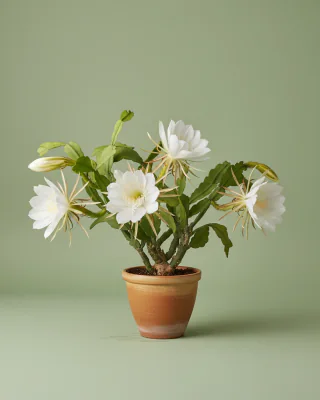
In English, "queen of the night" and "night-blooming cereus" are also used for Epiphyllum oxypetalum, a different cactus that also flowers at night. This page covers Selenicereus grandiflorus. You can tell them apart by the stems: Selenicereus has round, ribbed, spiny stems that climb, while Epiphyllum oxypetalum has flat, spineless, leaf-like branches. Epiphyllum is a forest cactus and wants bright, filtered light out of strong sun, so its care differs.
Two things decide whether it flowers: plenty of light, water and warmth while it grows, and a cool, dry, bright rest in winter. Its stems grow fast and long, so plan for a frame or trellis from the start.
Water freely in summer, keep it dry in winter
From spring to autumn, while it grows, it needs plenty of water. Water thoroughly once the surface of the compost feels dry, let the excess drain away and never leave the pot standing in water. Rainwater at room temperature is ideal, since minerals in tap water can build up in the compost.
From about November to early March, keep it almost dry. Water only if the stems start to shrivel. Watering a resting plant in winter encourages weak growth and can stop it from setting buds.
Light and placement
Give it a bright, sunny window. Cacti flower best with as much light as possible all year, and that includes the winter rest, so choose a bright spot for winter too. Too little light is one of the reasons a plant grows but does not flower.
Feeding
Feed it once a month from about April to September with a liquid feed high in potassium, such as a tomato feed, or a liquid cactus feed. Do not feed it during the winter rest.
Temperature & humidity
Keep it warm while it grows. In winter, give it a rest at about 10 to 14 °C (50–57 °F) in a bright, cool place such as a stairwell window, a conservatory or an unheated bedroom. Avoid long spells well below 10 °C (50 °F). It is not frost hardy. A spot above a radiator in a heated living room spoils the rest and usually means no flowers the next summer.
Ordinary room air is fine. In the growing season it appreciates misting now and then, and warmth with humid air helps it set buds. Keep it dry in winter.
Not confirmed pet-safe
Common questions
Why does my queen of the night not flower?
Usually because it had no proper winter rest or too little light. Keep it bright, cool at about 10 to 14 °C (50–57 °F) and almost dry from November to early March, then give it a sunny window, water and feed from spring. A warm winter spot above a radiator is a common cause of no flowers.
How long does a queen of the night flower last?
One night. The flower opens at dusk, is fully open around midnight and has faded by morning. A large plant can open many flowers over the summer, a few at a time.
Is this the same plant as Epiphyllum oxypetalum?
No. Both are called queen of the night and both flower at night, but Selenicereus grandiflorus has round, ribbed, spiny stems that climb, while Epiphyllum oxypetalum has flat, spineless, leaf-like branches. Epiphyllum wants bright, filtered light out of strong sun, while Selenicereus wants a sunny window.
How often should I water queen of the night?
From spring to autumn, water thoroughly each time the surface of the compost feels dry, and let the excess drain away. In winter, keep it almost dry and water only if the stems shrivel.
Where should I keep it in winter?
In a bright, cool place at about 10 to 14 °C (50–57 °F), such as a stairwell window, a conservatory or an unheated bedroom. Avoid long spells well below 10 °C (50 °F) and keep it away from radiators.
Does queen of the night need support?
Yes. Its long, thin stems climb with aerial roots and grow fast. Tie them to a frame, trellis or hoop so they stay tidy and take up less room.
How do I grow queen of the night from cuttings?
Cut a piece of healthy stem and let the cut end dry and callus for a day up to a week. Then insert it into a gritty mix, such as 2 parts compost to 1 part horticultural grit, and keep it only slightly moist until it roots.
Is queen of the night safe for cats and dogs?
We cannot confirm that. The ASPCA record called "Night Blooming Cereus (Queen of the Night)" is for a different cactus, the dragon fruit, and there is no record for Selenicereus grandiflorus. Keep it out of reach of pets and call your vet if your pet eats some.
Sources
- This guide follows established plant-care guidance and official ASPCA pet-safety references. How we verify our plant data →
- Sources: the RHS Selenicereus grandiflorus profile supports the common names and the native range. The RHS guide to cacti as houseplants supports the sunny window, as much light as possible for flowering, the watering, rainwater, the winter rest from November to early March, the monthly feed from April to September and the stem cuttings. The Botanical Garden of the University of Potsdam supports the cool, dry winter rest at about 10 °C (50 °F), plenty of water and occasional misting from May to autumn and the climbing stems that need taming, and its flowering notice supports the angled climbing stems and the flower size. The German Cactus Society (DKG) supports the winter rest at 10 to 14 °C (50–57 °F), avoiding long spells below 10 °C (50 °F) and radiator spots, the sunny window, feeding in growth, the frame, misting and humid warmth for buds, the aerial roots, the stem width and the flowering times. The Botanical Garden of the University of Münster supports the one-night flowers up to 30 cm (12 in). UF/IFAS Extension supports the shared common name and the lack of frost hardiness. The RHS Epiphyllum oxypetalum profile and the RHS epiphyllum guide support how the other queen of the night differs. The ASPCA plant database has no record for this species, so pet safety is not confirmed.
Last reviewed: