Lithops care guide
Lithops spp.
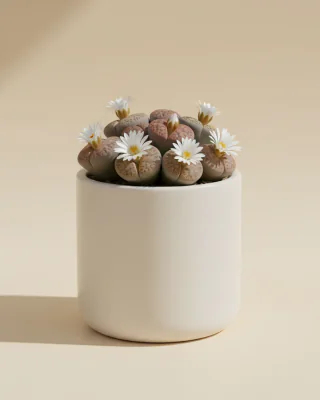
Lithops, or living stones, need full sun, a very gritty mix and water only when they are growing. Do not water at all while the new pair of leaves grows inside the old pair and the old pair shrivels, usually in winter and spring. Too much water kills more lithops than anything else.
 Not sure it’s this plant?Check yours with a photo, free
At a glance
- Light
- Full sun, ideally 4 to 5 hours of morning sun
- Water
- Only in growth, never while new leaves form
- Climate
- 18–27 °C (64–81 °F), never below 5 °C (41 °F)
- Humidity
- Dry room air, good airflow
- Pet safety
- Not confirmed pet-safe
A plant that runs on its own calendar
Lithops come from the dry parts of southern Africa, mainly South Africa and Namibia, where rain is scarce. Each plant is a pair of thick, fused leaves shaped like an upside-down cone, with a slit across the top and almost no stem. In the wild they sit almost flush with the ground and look like pebbles. The leaves store enough water to last for months, and a plant can live for 40 years or more.
Its yearly cycle decides everything. After flowering, a new pair of leaves starts to form inside the old pair. Through winter and spring the plant draws water and food from the old leaves, which shrivel into a papery skin while the new pair pushes out of the slit. Watering during this time keeps the old leaves alive and upsets the change. Overwatering is the main reason lithops die. The zebra haworthia, another small South African succulent, is far more forgiving about water.
Daisy-like yellow, white or pale orange flowers appear from the slit, mostly in autumn, and open on sunny afternoons. Over the years one plant can divide into a small cluster of heads. You can lift a cluster and carefully split it, or grow new plants from seed, which may flower after three or four years.
When to water, and when not to
Follow the plant, not the calendar. In winter and spring, while the new pair grows and the old pair shrivels, give no water at all. Once the old leaves have dried to a papery skin, usually in late spring, you can start watering. In the hottest part of summer it rests, so water very sparingly or not at all. If it shrivels badly then, give just enough to wet the top centimeter or so of the mix. Water more regularly from late summer, when the slit starts to open, into autumn. Stop once flowering is over.
When you water, soak the mix, then let it dry out completely, which can take one to two weeks, and wait a few more days before you water again. Water in the morning. If you are in doubt, do not water. Some wrinkling is normal when the old leaves are being used up or the plant is resting. Leaves that turn yellow, soft or mushy, or a plant that splits open, mean it has had too much water.
Light and placement
Give it as much light as you can. Four to five hours of direct morning sun with some afternoon shade is ideal, and a south window is best. An unobstructed east window also works. In too little light it stretches, leans, turns greener and loses its markings. Move a plant to stronger sun gradually so it does not burn.
Feeding
Feed sparingly, and only while it is growing. A low-nitrogen, high-potassium feed at half strength a few times in the growing season is plenty. Never feed it while it rests or while the new leaves form.
Temperature & humidity
Climate18–27 °C (64–81 °F), never below 5 °C (41 °F)
It grows best at about 18 to 27 °C (64–81 °F). It tolerates heat well as long as the air moves, but it must never freeze, so keep it above 5 °C (41 °F). A cool, bright windowsill in winter suits it while it is kept dry.
It needs no extra humidity. It comes from dry regions, and ordinary dry room air suits it. There is no need to mist it. Good air movement helps, especially in hot weather.
Not confirmed pet-safe
Common questions
How often should I water lithops?
There is no fixed schedule. Water only while it grows, from late spring and again from late summer into autumn, and let the mix dry out completely between waterings. Give no water in winter and spring while the new leaves form.
Why is my lithops wrinkling?
Often it is normal. The old pair of leaves shrivels as the new pair grows inside, and a resting plant wrinkles a little. If it shrivels badly in summer, wet only the top centimeter or so of the mix.
Why did my lithops split or burst?
Too much water. Splitting is a sign it has had more water than it can use. Let the mix dry out completely and water far less often.
Why is my lithops soft and mushy?
That is rot, usually from too much water. Stop watering, make sure the mix drains freely and keep the top of the plant just above the soil.
Why is my lithops getting tall?
It needs more light. In too little light it stretches, leans and loses its markings. Move it gradually to a south window or a spot with several hours of morning sun.
What soil do lithops need?
A very gritty, fast-draining mix, such as cactus mix with extra grit, sharp sand or perlite. Use a pot about 8 to 13 cm (3–5 in) deep with a drainage hole, because the roots spread wide.
When do lithops flower?
Mostly in autumn, sometimes from late summer into early winter. The daisy-like flowers grow from the slit between the leaves and open on sunny afternoons.
Are lithops safe for cats and dogs?
We cannot confirm that. ASPCA lists only one species, Lithops naureeniae, as non-toxic and has no record for lithops in general. Keep it out of reach of pets and call your vet if one eats some.
Sources
- This guide follows established plant-care guidance and official ASPCA pet-safety references. How we verify our plant data →
- Sources: Wisconsin Horticulture Extension supports the origin, the leaf structure, the yearly leaf change, the watering cycle, letting the mix dry completely, overwatering as the main cause of death, the light, the pot depth, the feed, flowering, dividing and growing from seed. NC State Extension supports the 18 to 27 °C (64–81 °F) range, the cold limit, the morning sun, stretching in low light, the gritty mix, and yellow, mushy and split leaves from overwatering. The RHS Lithops profile, Lithops lesliei profile and Lithops hallii profile support the full sun, gritty compost, watering only in growth, the half-strength feed, offsets, mealybugs and frost tenderness. The RHS cacti and succulents growing guide supports the dry, cool winter rest and shriveling from underwatering. NDSU Extension supports no water while new leaves form and the fast-draining soil. The ASPCA living stones record covers only Lithops naureeniae, so pet safety for lithops in general is not confirmed.
Last reviewed: