



Types of hoya
Hoya carnosa
Quick answer
Common types of hoya include Hoya carnosa, its curled Compacta form, heart-leaved Hoya kerrii, silver-flecked Hoya pubicalyx, small-leaved Hoya bella and rounded-leaved Hoya australis. Most climb or trail and need bright, indirect light with good drainage. Leaf shape helps narrow the choice, but a named label is more reliable than one leaf.
 Not sure it’s this plant?Check yours with a photo, free
Pet-safe
Types of hoya
- 01
Wax plant (Hoya carnosa)
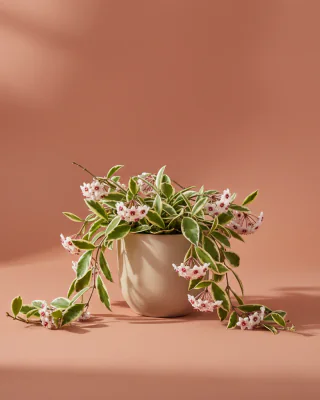
Hoya carnosa has thick, waxy, oval leaves and rounded clusters of pale pink or white star-shaped flowers. Some leaves have silver or cream flecks.
Use a loose, fast-draining mix and let it dry between waterings. Leave the old flower spurs in place because they can flower again.
Pet safety: non-toxic to cats and dogs.
- 02
Hindu rope hoya (Hoya carnosa ‘Compacta’)
Compacta has tightly curled, contorted leaves along trailing stems. NC State lists it as a form of Hoya carnosa, also called Krinkle Kurl, rather than a separate species.
Its care follows carnosa: bright, indirect light, good drainage and a drying period between waterings. The curled leaves do not need a different watering timetable.
Pet safety: non-toxic to cats and dogs.
- 03
Sweetheart hoya (Hoya kerrii)
Kerrii has thick, heart-shaped leaves. A single rooted heart leaf often fails to become a vine if it was sold without any stem tissue.
Let the mix dry somewhat between waterings. A growing plant needs room to trail or a support to climb, unlike the single-leaf gift pots.
Pet safety: non-toxic to cats and dogs.
- 04
Hoya pubicalyx
Look for long, narrow, glossy green leaves, often with silver flecks. Its flowers form pink clusters. Silver spotting alone is not proof of the species because carnosa can also have flecks.
Give it a climbing support, bright filtered light and a mix that drains well. Let the mix dry between waterings and keep it away from drying heater vents.
Pet safety: non-toxic to cats and dogs.
- 05
Miniature wax plant (Hoya bella)
Bella has small, pointed leaves on slender, cascading stems. Its white star-shaped flowers have pinkish-purple centers. It is also found on labels as Hoya lanceolata subsp. bella.
It suits a hanging pot. NC State recommends letting the soil become almost dry before watering and leaving the flower spurs intact after blooming.
Pet safety: not confirmed for cats and dogs. Keep it out of reach.
- 06
Hoya australis
Australis has thick, smooth leaves that are rounded to oval, with fragrant white flowers marked red in the center. It is a climbing species rather than a carnosa cultivar.
Give it bright light, good drainage and space to climb. Avoid overwatering and keep the old flowering stalks for future blooms.
Pet safety: not confirmed for cats and dogs. Keep it out of reach.
- 07
How care changes between hoya types
Growth habit determines whether you need a support or a hanging pot. Carnosa and pubicalyx climb, while bella makes a smaller trailing display. Drainage matters for every type, and their species notes above explain how far to let the mix dry.
Pet safety is listed separately for each named type. Bella and australis remain not confirmed, so a non-toxic carnosa verdict does not transfer to them.
Common questions
Is Hindu rope a different hoya species?
NC State lists Compacta, also called Krinkle Kurl, as a form of Hoya carnosa. Its curled leaves look different, but it follows the same care routine.
Will a single Hoya kerrii leaf grow into a vine?
Not reliably. NC State notes that a rooted leaf is unlikely to grow well unless the cutting included some stem tissue.
Are all types of hoya safe for pets?
Do not assume that. Carnosa, Compacta, kerrii and pubicalyx are listed here as non-toxic. Bella and australis remain not confirmed.
All wax plant guides
Sources7 references
- NC State Extension Plant Toolbox: Hoya
- NC State Extension Plant Toolbox: Hoya carnosa
- NC State Extension Plant Toolbox: Hoya kerrii
- NC State Extension Plant Toolbox: Hoya pubicalyx
- NC State Extension Plant Toolbox: Hoya bella
- NC State Extension Plant Toolbox: Hoya australis
- ASPCA: Wax plant (Hoya carnosa ‘Krinkle Kurl’)
Last reviewed: