


Overwintering a windmill palm
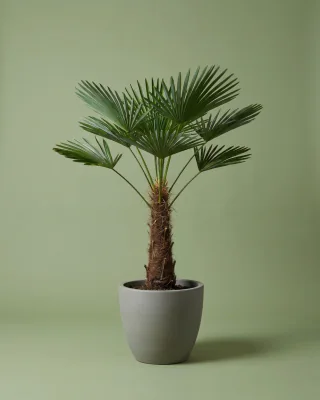
Trachycarpus fortunei

Quick answer
The windmill palm (Trachycarpus fortunei) is one of the hardiest palms. Planted in the ground it takes about minus 10 to minus 15 °C (14–5 °F) according to the RHS, but needs shelter from cold wind and hard frost. In a pot the root ball freezes much faster: wrap the pot or move the palm somewhere bright and cool indoors.
 Not sure it’s this plant?Check yours with a photo, free
Pet-safe
Overwintering a windmill palm
- 01
How hardy is a windmill palm?
For a palm it is very hardy. The RHS rates it hardy in most of the UK even in severe winters, at about minus 10 to minus 15 °C (14–5 °F). It still needs protection from strong, cold drying winds and hard winter frosts.
Young plants are more sensitive than older, established ones.
- 02
Overwintering a windmill palm in a pot
In a pot, frost reaches the root ball from all sides, and roots take cold worse than the trunk and leaves. A pot therefore needs more protection than a palm in the ground.
If the pot stays outside, wrap it in several layers of bubble wrap or a coir mat, or stand it in a bigger container filled with leaves, straw or bark. Cover the soil with about 10 cm (4 in) of leaves and keep the drainage hole clear. A sheltered spot against a wall helps too.
- 03
Overwintering it indoors
In cold areas a windmill palm in a large pot can overwinter indoors. Choose a bright, cool room. Botanicaly’s plant data says a cool room is fine as long as it stays above 0 °C (32 °F). The darker the room, the cooler it should be.
Move it in as late as you can and check it for pests first.
- 04
Protecting a palm in the ground
Plant it in a sheltered spot in full sun or light shade. Strong wind tears the leaves, and cold, drying wind does extra damage in winter.
In a hard frost even a planted palm needs protection, especially while it is young.
- 05
Watering and feeding in winter
It needs much less water in winter. Water a pot only when the top 5 cm (2 in) of soil are dry, and never leave water in the saucer. Soggy soil can lead to root rot.
While it isn’t growing in winter, it needs no feeding.
- 06
Pests and pruning
Serious pests are rare. Scale insects and palm aphids can show up in winter quarters.
The RHS says no pruning is required.
- 07
When it can go back outside
A palm kept indoors can go out in mild weather, often from March or April, first during the day and in light shade. Keep fleece ready for cold nights and bring it back in for frost.
- 08
Common mistakes
An unprotected pot: the root ball freezes far faster in a pot than in the ground.
Soggy soil: a blocked drainage hole or water in the saucer rots the roots.
A windy spot: cold, drying wind does extra damage to the leaves in winter.
Common questions
Is a windmill palm hardy?
Yes, very for a palm. In the ground it takes about minus 10 to minus 15 °C (14–5 °F) according to the RHS, but needs shelter from cold wind and hard frost.
Can a potted windmill palm stay outside in winter?
Yes, with the pot wrapped, leaves over the soil, the drainage hole clear and a sheltered spot. In a pot the root ball freezes faster than in the ground.
Can I overwinter a windmill palm indoors?
Yes, in a bright, cool room. A cool room is fine as long as it stays above 0 °C (32 °F).
Should I water a windmill palm in winter?
Yes, but little. Water only when the top 5 cm (2 in) of soil are dry and avoid soggy soil.
All windmill palm guides
Sources5 references
Last reviewed: