



Pink Princess and other blushing philodendrons
Philodendron erubescens
Quick answer
Pink Princess is a cultivar of the blushing philodendron, Philodendron erubescens, with dark green to purplish leaves splashed with pink. Grow it like the species: bright, indirect light without direct sun, and water when the top 4 cm (2 in) of mix is dry. Bright light keeps the pink coming, and a shoot that turns all green should be cut back to a leaf with pink.
 Not sure it’s this plant?Check yours with a photo, free
Toxic to pets
Pink Princess and other blushing philodendrons
- 01
What a Pink Princess philodendron is
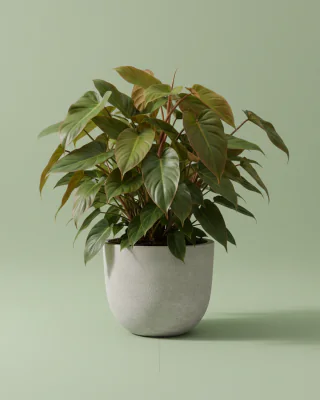
NC State lists Pink Princess as a cultivar of Philodendron erubescens with an upright, vining habit and heart-shaped, dark purplish-green leaves with pink variegation. The RHS describes glossy deep green leaves splashed with cream and pink, on thick stems that are bright red when young.
It climbs with clinging stems, so give it a moss pole or stake. The RHS gives it an eventual height of 1 to 1.5 m (3 to 5 ft).
- 02
Pink Princess philodendron care
Light: bright, indirect light. NC State advises avoiding direct sunlight, and midday sun can scorch the leaves. A spot 1 to 2 m (3 to 6 ft) back from an east or west window works.
Water: when the top 4 cm (2 in) of mix feels dry, as for any blushing philodendron. Let the pot drain and never leave it standing in water. In winter it needs water less often.
Warmth: keep it indoors all year. The RHS rates it as needing heated protection.
Pests: the RHS names scale insects and glasshouse red spider mite. Check the undersides of the leaves when you water.
- 03
How to keep a Pink Princess pink
Light is the main lever. The RHS says a permanent loss of variegation usually means too little light, so move a Pink Princess that is fading toward the window, still out of direct sun.
If a shoot comes out all green, it has reverted. Green growth is more vigorous and can take over, so the RHS advises cutting reverted shoots back to growth with variegation. Wear gloves before you cut, because the sap can irritate skin, then cut just above a leaf that still shows pink.
A leaf with little or no green has less chlorophyll to feed itself. The RHS notes that all-white or pale shoots on variegated plants are very weak, so a plant with mostly pink leaves needs more green leaves to stay strong.
- 04
White Princess, Red Emerald and other blushing philodendrons
White Princess has green leaves splashed with white instead of pink (NC State). Red Emerald is a climber with deep red leaf stalks, lime green new leaves and deep green mature leaves. Green Emerald is a vining form with glossy deep green leaves that are reddish purple underneath.
Prince of Orange is not a form of Philodendron erubescens but a related hybrid of several species, P. erubescens among them (US plant patent PP6797). It is a compact, bushy, non-vining plant whose leaves open orange, turn copper and end deep green. Tangerine is a hybrid too, of Philodendron ‘Moonlight’ and Prince of Orange, with orange to bronze leaves.
To tell Pink Princess from White Princess, look at the color of the variegation: pink on dark purplish green for Pink Princess, white on green for White Princess. Care is the same for all of them.
- 05
Pet safety
Pink Princess and the other blushing philodendrons are toxic to cats and dogs. The leaves contain calcium oxalate crystals that irritate the mouth and stomach if chewed, and the sap can irritate skin.
Common questions
Why is my Pink Princess philodendron losing its pink?
Most often too little light. Move it closer to a bright window, out of direct sun, and cut any all-green shoot back to a leaf that still shows pink.
How much light does a Pink Princess need?
Bright, indirect light, for example 1 to 2 m (3 to 6 ft) back from an east or west window. Direct sun scorches the leaves.
How often should I water a Pink Princess philodendron?
When the top 4 cm (2 in) of mix is dry. Check with a finger rather than watering on a fixed day, and water less in winter.
What is the difference between Pink Princess and White Princess?
The color of the variegation. Pink Princess has pink on dark purplish-green leaves. White Princess has white on green. Both are grown the same way.
Is a Pink Princess philodendron toxic to cats?
Yes. It contains calcium oxalate crystals that irritate the mouth and stomach of cats and dogs.
All blushing philodendron guides
Sources5 references
Last reviewed: