

Fuchsia care guide
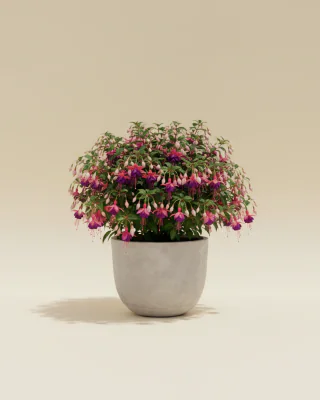
Fuchsia magellanica
During active leafy growth, water as needed to keep the compost from drying out, while letting excess drain. For a cool, dark, leafless winter rest, check the root ball and water sparingly so it does not dry out completely.
 Not sure it’s this plant?Check yours with a photo, free
At a glance
- Light
- Bright, indirect light
- Typical interval
- Every 3 to 5 days · summer
Leafless rest: water sparingly. · winter - Climate
- 5–24 °C (41–75 °F)
- Humidity
- 50–70%
- Pet safety
- Pet-safe (non-toxic)
When and how to water
- Summer · Jun–AugEvery 3 to 5 days
- Winter · Dec–FebLeafless rest: water sparingly.
During active leafy growth, water as needed to keep the compost from drying out, while letting excess drain. For a cool, dark, leafless winter rest, check the root ball and water sparingly so it does not dry out completely.
Light and placement
Bright, indirect light
Fuchsia thrives in bright, indirect light. Direct midday sun can scorch the leaves. Place it 1–2 meters back from an east or west window, or behind a sheer curtain on a south window.
Feeding
Feed your Fuchsia every 14 days while it’s actively growing. Use a balanced liquid houseplant fertilizer at half the strength on the label, and only on soil that’s already damp. Feeding dry roots can scorch them.
When growth pauses, skip the fertilizer and let it rest.
Temperature & humidity
Humidity50–70%
Fuchsia magellanica is a hardy fuchsia (RHS H4, about −10 to −5 °C / 14–23 °F). Planted out, it survives an average winter. In a pot, move it to a sheltered or frost-free spot in hard frost.
It does best at 50–70% humidity. It doesn’t need misting.
Overwintering fuchsias
Bring tender potted fuchsias in before the first frost and keep them bright and cool at 4 to 8 °C (39–46 °F), or in a cool dark basement. Fuchsia magellanica is hardy (RHS H4, about −10 to −5 °C / 14–23 °F): planted out it survives an average winter, and in a pot it moves to a sheltered or frost-free spot in hard frost.
Toxic to pets?
No. Pet-safe.
Fuchsia is non-toxic to cats and dogs. Safe to keep in a home with pets.
Pet-safety information in the JungleBook uses ASPCA reference data where available. It is reference information, not veterinary advice. ASPCA lists the whole Fuchsia genus, so this applies to every Fuchsia species, including this one.
Sources5 references
- Royal Botanic Gardens, Kew: Plants of the World OnlineTaxonomy · accepted name · classification
- Royal Horticultural SocietyPosition · soil · hardiness · pests · diseases
- North Carolina State University Extension Gardener Plant ToolboxLight · soil · hardiness · mulch · salt exposure · outdoor problems
- University of Illinois ExtensionContainer culture · light · moisture · feeding · organic soil · overwintering
- ASPCA Animal Poison ControlScientific name and toxicity classification · non-toxic genus record
Last reviewed: